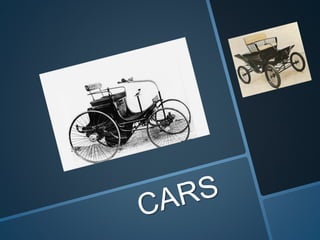
The history of automotive vehicles began in the 18th century with steam-powered cars. Early attempts to build self-propelled vehicles used steam, electricity, and gasoline as means of propulsion. The first true steam-powered car was built in 1769 by Nicholas Cugnot, but it was too heavy and noisy. In the following decades, inventors experimented with steam, electric, and gasoline engines to power early automobile prototypes. The first successful gasoline-powered automobile, the Benz Patent-Motorwagen, was invented in 1886 by Karl Benz. Mass production of automobiles began in the late 19th century in both France and the United States, establishing the world's first automobile companies.
A brief introduction to the benefits of electric vehicles and how they are now becoming part of particular industries. GLH is a leading London Private Car Hire company. www.glh.co.uk
The first self-propelled vehicle was invented in 1769 by Nicolas Joseph Cugnot and was powered by steam. It traveled at speeds between 12-21 mph but had to stop every 10-15 minutes to build up steam. The Borodino steam carriage, introduced later, resembled a horse-drawn carriage but had a steam engine in the back. The internal combustion engine, invented by Belgian Etienne Lenoir, did not require waiting for steam and made starting a vehicle quicker. Carl Benz and Gotlieb Daimler helped popularize the combustion engine in the 1880s. Early cars resembled horse-drawn carriages and were called "horseless carriages." They were hand-built, expensive
Automobile Industry - history, evolution & growthRohith Sainoji
The document provides an overview of the history and development of automobiles. It discusses key events and innovations such as Cugnot building the first steam-powered vehicle in 1769, Benz receiving a patent for the first gasoline-powered automobile in 1886, and Ford revolutionizing production with assembly line techniques beginning in 1914. The document also covers the growth of the global automobile industry in the 20th century and its current challenges around sustainability and external competition from public transportation.
Electric vehicles first gained popularity in the late 19th century as battery technology advanced, allowing for higher speeds. By the early 20th century, electric vehicles were more popular than gas-powered cars due to their reliability. However, as the price of electric cars increased and fossil fuels became cheaper, gas vehicles rose in demand. Interest in electric vehicles renewed in recent decades due to higher gas prices and environmental regulations. Now, battery technology provides electric vehicles with ranges over 200 miles, and many major automakers are producing electric car models as their popularity continues to grow.
The document summarizes the evolution of cars from their origins with steam-powered vehicles in the late 18th century to modern electric and alternative fuel vehicles. It outlines six eras of car production: Veteran Era (1880s-1903), Edwardian Era (1903-1915), Vintage Era (1919-1930), Pre-World War II Era (1930-1947), Post-World War II Era (1947-1970s), and the Modern Era (1965-). For each era, it highlights technological innovations and examples of influential car models that helped advance the automobile industry.
El documento resume la historia y evolución del automóvil desde su invención en el siglo XVIII hasta la actualidad. Destaca que los primeros prototipos se crearon a finales del siglo XIX y que la historia se divide en etapas marcadas por hitos tecnológicos como la introducción del motor de gasolina en 1885. Luego describe algunos de los modelos y avances más importantes de cada etapa que llevaron al desarrollo del automóvil moderno.
The document summarizes the evolution and life cycle of cars from their invention to modern times. It describes key developments in early steam-powered vehicles in the late 18th century, followed by gasoline-powered cars in the late 19th century pioneered by Karl Benz. Henry Ford later revolutionized car production with the assembly line in the early 20th century. The document then outlines the various stages in a car's life cycle from raw material extraction and assembly to consumer use, repair, and eventual recycling of parts at the end of its life.
Retail layout analysis of Royal enfieldWansuklangk
Royal Enfield is an Indian motorcycle company originally from Britain. It has over 700 dealers in India, including 14 in Bangalore. One dealer, Teknik Motors in Indiranagar, believes in establishing long-lasting customer relationships. The showroom has a prime location and wide selection of Royal Enfield motorcycles. Sales staff are well-trained to provide information to customers. The competitor CVS Motors lacks in customer satisfaction after delivery. Teknik Motors has a large floor space and displays Royal Enfield's history and all motorcycle models outside to attract customers.
The document summarizes the history and development of automobiles from the first steam-powered car built by Joseph Cugnot in 1769 to modern cars with computer-controlled systems. It notes key developments like the first internal combustion engine (Jean Joseph Étienne Lenoir), four-cylinder engine (Nikolaus August Otto), four-wheeled automobile (Gottlieb Daimler), and Model T (Henry Ford). Over time, cars gained new technologies, styles evolved between World Wars, and computer chips now control many systems. Top modern brands include Toyota, Volkswagen, Mercedes, and BMW.
Electric cars and gasoline cars are compared based on various factors such as year of invention, fuel, powertrain, weight, vehicle range, fuel economy, maintenance, pollution, noise, battery replacement, and refill/recharge processes. While electric cars were invented earlier, gasoline cars became more popular due to readily available fossil fuels. Electric cars are heavier due to batteries but have fewer moving parts requiring less maintenance. They produce no tailpipe emissions but have a shorter range between charges compared to gasoline cars. Overall operating costs of electric cars are lower due to cheaper refueling and maintenance.
Cities like London and Amsterdam are investing in electric vehicles, with over 1,000 charging points installed. Milan is considering following this trend through the e-moving project, which plans to install 31 charging points. The research analyzes Milan residents' attitudes toward the Renault Twizy electric vehicle and its potential profitability. A survey was conducted of 205 Milan residents, finding high concern for environmental issues like air pollution. Electric vehicles were seen as one solution, and the Twizy's small size makes it suitable for Milan's context.
The document summarizes a research project report on the future of electric vehicles submitted for a bachelor's degree. It includes an acknowledgement section thanking those who supported the project. The objectives section outlines the goals of studying consumer perceptions and expectations of electric vehicles. An executive summary provides an overview of the automotive industry in India and electric vehicle market.
Amazin Bikes is an Indian manufacturer of bicycles that is developing a 3-year plan to enter the US market. It currently supplies 95% of its bicycle parts domestically in India. The US bicycle market is worth $6.2 billion in imports and has over 59 million cyclists. Amazin Bikes faces threats from Chinese competition with lower production costs and potential US import taxes. Its financial plan budgets $6 million Indian rupees for costs associated with factory setup, R&D, production, warehousing, exporting, and promotion.
Car Evolution - From the Past to the FutureNutleyKia
Take a look at the evolution history of automobile and what it will be in the future. For classic car lovers, this is a slideshare you do not want to miss. Learn more about car tips and fun facts at Nutley Kia's blog www.nutleykia.com/blog
Mr. Kamble Sagar presented on the history, evolution, and future of automobiles. The document discussed the early history of automobiles from steam-powered vehicles in the 17th century to Karl Benz's gas-powered Motorwagen in 1885. It covered the types of engines used in cars from gasoline and diesel to future technologies like electric, hydrogen, and air-powered engines. The document concluded with a discussion of innovations in automobiles including hybrids, hypercars, ultra-light cars, and self-driving vehicles.
The document provides details on the renovation plans for a Royal Enfield store. It discusses [1] the history and objectives of Royal Enfield, [2] the types of current and potential future products to showcase, and [3] how the store space could be organized into different functional zones like a bike display, merchandising, and service area. The overall goal is to recreate and reinforce the brand experience through the store's design.
Daimler designed the first four-wheeled automobile in the late 1800s. Karl Benz is credited with building the first automobile powered by an internal combustion engine in 1885. Throughout the early 20th century, automobiles continued to evolve with improvements like synchronized transmissions, braking systems, and new materials. By the late 20th century, computer technology began to be used more in automobiles to control systems like anti-lock brakes and GPS navigation. Today's cars are increasingly computerized and made with lightweight but strong materials.
The document summarizes the history of automobiles from their origins in the late 18th century to modern developments. It notes that Karl Benz is considered one of the founders of Mercedes-Benz and built the first automobile powered by an internal combustion engine in 1885. It then outlines key developments over the 20th century like the introduction of synchronized transmissions, braking systems, and new materials. The document concludes that computers now control many vehicle systems and autonomous vehicles may be the future of transportation.
The document traces the history and development of cars from their earliest origins to modern times. It discusses the first wind-powered vehicle invented in 1335, followed by the first steam-powered vehicle invented by Nicolas Joseph Cugnot in 1769. Electric vehicles were also an early focus, with the first electric carriage invented in 1832. Internal combustion engines were subsequently developed, starting with Christian Huygens' gunpowder design in 1680 and culminating in Daimler's four-stroke gasoline engine in the late 1800s. The gasoline car went on to outsell other vehicle types in the early 1900s, with early manufacturers including Panhard & Levassor, Peugeot, and RansomeEli Olds'
The development of the automobile began in the late 17th century. Steam power was an early attempt at portable power but internal combustion engines eventually proved more practical. The first internal combustion engine automobile was built in 1885 by Karl Benz. Henry Ford's assembly line techniques helped the Model T become the first affordable automobile for mass consumption in the early 20th century. Modern features like power steering, air conditioning, and electronics have since been incorporated to enhance comfort, safety and navigation.
The development of the automobile began in the late 17th century. Steam power was an early attempt at portable power but internal combustion engines eventually proved more practical. The first internal combustion engine automobile was built in 1885 by Karl Benz. Henry Ford's assembly line techniques led to mass production of affordable cars in the early 1900s. Key developments included electric starters, power steering, headlights, radiators, air conditioning, differentials, radios, and navigation systems to produce the modern automobile.
The early history of the automobile saw experimentation with various propulsion methods including steam, electricity, and internal combustion engines using gases and liquids as fuels. Nicolas-Joseph Cugnot is considered by some to have built the first self-propelled mechanical vehicle in 1769 powered by a steam engine. Karl Benz developed and produced the first automobile recognized as such in 1885, powered by an internal combustion engine using gasoline. Henry Ford's Model T, first produced in 1908, was the first automobile mass-produced on moving assembly lines, making automobiles affordable for the masses.
Several early inventors designed steam and gasoline powered vehicles in the late 18th and 19th centuries. Gottlieb Daimler built a wooden motorcycle in 1885. Karl Benz drove his gasoline-powered tricycle in 1885. Charles and Frank Duryea built the first successful gasoline-powered car in America in 1893. Their single-cylinder, 4 HP car with friction transmission and low-tension ignition was driven on public roads in Massachusetts. Early vehicles struggled with reliability and practicality issues on roads until advances like the internal combustion engine and gasoline fuel made automobiles more viable.
The document provides a detailed history of the automobile from its early origins to modern developments. It discusses key milestones and inventors including:
- The first self-propelled road vehicle in 1769 powered by a steam engine. Early vehicles relied on steam power but were inefficient.
- Inventors in the late 1800s who developed early gasoline and diesel internal combustion engines, including Nikolaus Otto's 1876 four-stroke engine and Gottlieb Daimler and Wilhelm Maybach's 1885 vertical cylinder engine with a carburetor.
- Karl Benz's 1885 patent for the first practical three-wheeled automobile and his later four-wheeled designs in the 1880s, considered the first modern
Automobile History for Engineering Studentskgmahesh123
The document provides a detailed history of the automobile from its early origins to modern developments. It discusses key milestones and inventors including:
- The first self-propelled road vehicle in 1769 powered by a steam engine. Early vehicles relied on steam power but were inefficient.
- Inventors in the late 1800s who developed early gasoline and diesel internal combustion engines, including Nikolaus Otto's 1876 four-stroke engine and Gottlieb Daimler and Wilhelm Maybach's 1885 vertical cylinder engine with a carburetor.
- Karl Benz's 1885 patent for the first practical three-wheeled automobile and his later four-wheeled designs in the 1880s, considered the first modern
The document provides a detailed history of the automobile from its early origins to modern developments. It discusses key milestones and inventors including:
- The first self-propelled road vehicle in 1769 powered by a steam engine. Early vehicles relied on steam power but were inefficient.
- Inventors in the late 1800s who developed early gasoline and diesel internal combustion engines, including Gottlieb Daimler and Karl Benz who are credited with creating the first modern gasoline-powered automobiles.
- Henry Ford's innovations with the assembly line in 1913 which reduced production costs and made automobiles affordable for the masses with the Model T, selling over 15 million units.
- Important models like the
From Europe to the US Japan and onto China: The evolution of the automobile i...Murray Hunter
This document provides a historical overview of the evolution of the automobile from its origins in Europe in the late 18th century to its development in the US and Japan and more recently in China. It discusses early steam-powered vehicles and developments that led to gasoline-powered internal combustion engines. Pioneers like Daimler, Benz, and Ford are credited with important innovations that advanced automotive technology and popularity. The document also outlines the parallel development of key components like rubber tires by Thomson, Dunlop, and Michelin. It concludes by noting the recent rise of Chinese automakers like BYD, Lifan, and Geely as the fourth generation of modern automobile manufacturers.
1) The document discusses the history of cars from early steam-powered vehicles in the 1700s to the development of gasoline-powered combustion engines and mass production in the late 1800s and early 1900s.
2) It notes key events like Karl Benz inventing the first gasoline-powered car in 1886 and Henry Ford developing the Model T for mass production.
3) The final section covers advantages and disadvantages of car usage, noting they provide convenience and speed but require money, cause pollution, and can lead to accidents.
A car (or automobile) is a wheeled motor vehicle used for transportation. Most definitions of cars say that they run primarily on roads, seat one to eight people, have four tires, and mainly transport people rather than goods.
The history of automobile where they startRydenBueno
The development of the automobile began in the late 17th century with early steam-powered vehicles and the first steam-powered car built in 1769. In the early 19th century, inventors created some of the first internal combustion engines and electric motors to power cars. The first modern, practical automobile for everyday use appeared in 1886 when Carl Benz developed a gasoline-powered car and began mass production. In the late 19th and early 20th centuries, many inventors and companies, including Oldsmobile and Ford, further advanced automotive technology and pioneered assembly line production, making cars more widely available and affordable to the public.
The internal combustion engine evolved over centuries from early designs in the 17th century to widespread adoption in the late 19th century. Key developments included Lenoir producing the first engine to run on gas in 1859, Otto designing the first true internal combustion engine in 1862 that sparked industry support, Daimler inventing the first gas-powered vehicle in 1885, and Diesel receiving a patent for his compression ignition diesel engine in 1893, cementing different engine technologies that are still used today.
This document provides a timeline of key developments in self-propelled vehicles from 1335 to 1886. Some of the earliest developments include a windmill-driven war wagon designed by Guido da Vigevano in 1335 and a clockwork-driven tricycle designed by Leonardo Da Vinci in 1478. Other important milestones mentioned include Nicholas Cugnot's steam-powered vehicle in 1769, widely considered the first automobile; Richard Trevithick's steam locomotive demonstration in 1801; and Karl Benz's gasoline-powered automobile, the Benz Patent-Motorwagen, in 1886, regarded as the first practical automobile. The timeline shows the progression from early human-powered vehicles to early steam-powered
The automobile revolution began in the late 18th century with early experiments by inventors like Trevithick and Cugnot. Major advances occurred during the Industrial Revolutions of the late 1700s and early 1800s with the development of steam power, as well as the second Industrial Revolution from 1870-1880 with the rise of oil and electricity. These technological changes enabled mass production of affordable automobiles in the late 1800s and early 1900s, driving major social and economic changes as automobiles became widely adopted.
Nicolas-Joseph Cugnot built the first self-propelled mechanical vehicle in 1769. Rudolf Diesel developed the compression ignition engine in the late 19th century. The first practical petrol engine was built by Nikolaus Otto in 1876. Karl Benz received a patent for the first practical motorcar, powered by a petrol engine, in 1886. In the early 20th century, hybrid vehicles began to emerge, combining petrol engines with electric motors. Automotive technology has since focused on improving comfort, safety, and value for humans.
The document summarizes the evolution of cars from early designs in the 1300s to modern times. It describes key developments like the first internal combustion engine in the 1800s, the first vehicle to move under its own power in 1769, early experiments with fuels like gunpowder and coal gas, and innovations like the gasoline engine, hybrid vehicles, fuel injection, catalytic converters, and fuel cells. It traces the transition from steam and gas power to gasoline and highlights early pioneers and models like the Model T that helped popularize automobiles.
The document summarizes the history and development of automobiles. It describes how the first self-propelled vehicles were invented in the late 18th century in France. In the late 19th century, gasoline-powered engines were developed and cars became popular recreational vehicles for the wealthy. Henry Ford later invented the affordable Model T in 1908, making cars accessible to the masses. Throughout the 20th century, automotive technology advanced with new features such as automatic transmissions, airbags, and computer-assisted driving systems.
In the late 1800s, German inventors Karl Benz and Gottlieb Daimler independently developed early automobile prototypes powered by internal combustion engines. In 1888, Bertha Benz, wife of Karl Benz, took the first road trip in their motorwagen from Mannheim to Pforzheim in Germany to promote her husband's invention. By the early 1900s, automobiles had become commercially viable, mass-produced products that began transforming transportation, infrastructure, and culture around the world. Major developments in the following decades included the rise of the American auto industry, the expansion of highways and suburbs, increasing popularity of customization, and growing environmental and safety concerns associated with automobile use.
Strategies for Adoption of SDGs in organizationsAmgad Morgan
A research document about designing and developing strategies for adoption of SDGs in organizations, the study covers the following entities:
Governmental Sector, Private Corporates, Small and Medium Sized Companies and Non-Governmental Organization.
The study is covered in 2 sections: first, developing different strategies that match each and every organization; and second, building the metrics and measures to measure the performance of the organization during and after the implementation.
The Haldia Port (Bengali: হলদিয়া বন্দর), officially Haldia Dock Complex (HDC), is a port on the confluence of the Haldi River and the Hooghly River. The port is located at Haldia in West Bengal, about 130 kilometres (81 mi) from the sandheads–deep sea area of the Bay of Bengal, 45 kilometres (28 mi) upstream from Pilotage Station at Sagar and 104 km (65 mi) downstream of Kolkata. In 1968, an oil jetty was commissioned at Haldia, and officially in 1977 the port facility of Haldia started functioning as a subsidiary port of the Port of Kolkata under the name Haldia Dock Complex.
Ethical Conduct and Dynamics of Attitudinal Change for Organizational Growth and Development Dubai - Prof Oyedokun
Being A Paper Presented at the Institute of Personality Development & Customer Relationship Management IPDCRM: DUBAI 2022 Corporate Charisma Conference & Induction Theme: Integrating Organisational Sustainability with Personality Development from September 26-October 1, 2022
2. The history begins with automotive vehicles propelled by steam 18th
century.
Trying to obtain a driving force to replace the horses back to the
seventeenth century. The car goes through the three eras of
the prevalent means of propulsion. : steam, electricity and gasoline.
The first steam car (1769) is the "Fardier" created by Nicholas
Cugnot, too heavy and noisy.
3. In 1770 he built a second model, larger than the first, and which could
handle 4.5 tons at a speed of 4 km. / h. This version was produced which
could be considered 'first car accident' of history,
Cugnot yet had time to build a third version in 1771, which remains
exposed today in the National Technical Museum in Paris.
4. In 1784 William Murdoch built a model steam carriage and in
1801 Richard Trevithick drove a vehicle in Camborne (UK) .In
such innovations as the first vehicles handbrake and steering
wheel speeds were developed.
5. In 1807, François Isaac de Rivaz
designed the first car powered by an
internal combustion engine fuelled by
hydrogen.
6. In 1815 Josef Bozek, built a self
propelled motor oil. Walter Hancock,
In 1838, Robert Davidson built an
electric locomotive that
reached 6 km / h.
7. Between 1832 and 1839 Robert Anderson invented the first car
powered by non-rechargeable electric cells.
Around 1870, in Vienna, inventor Siegfried Marcus
operated the internal combustion engine based
gasoline, known as the "First Marcus Car". In 1883,
Marcus patented a low voltage ignition was
introduced on these models.
8. In 1886 the first petrol or gasoline powered auto-mobile the Benz
Patent-Motorwagen was invented by Karl Benz
9. 1889 German engineer Emil Capitaine
combustion engine develops a two-stroke
high compression. This creates
an ancestor to the diesel engine.
Tunbridge Wells in 1895 held the first exhibition of cars in Britain,
even if it is rather a display of privately owned vehicles.
1895.Los brothers Charles and Frank Duryea founded in Lansing
(Michigan) the Duryea Motor Wagon Company. It is the first
company established in the United States to engage in the
commercial manufacture of automobiles.
1896.Henry Ford builds his first vehicle
quadricycle motor (quad) and performs
the first dynamic tests. The same year,
Ransom Eli Olds and Alexander Winton
also end his first experimental vehicles.
10. In 1900, the mass production of automobiles had begun in France
and the United States. The first automobile companies were
created to manufacture the French Panhard et Levassor and
Peugeot
11. Researchers appear little by little improving security at cars as well
as the first anti-theft systems; the cars are improved in many ways:
gearbox, wheels, bodywork; even styles change to suit the times.
Appear the first electric
vehicles, possible sources of
renewable energy
are searched