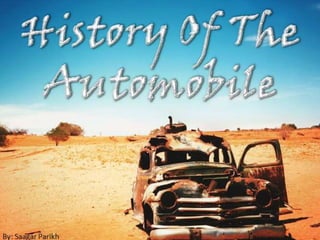
This is the history of one of man's greatest inventions.... The Car! This slideshow discusses the major accomplishments in chronological order since the very beginning of the automobile.
The document summarizes the evolution of cars from their origins with steam-powered vehicles in the late 18th century to modern electric and alternative fuel vehicles. It outlines six eras of car production: Veteran Era (1880s-1903), Edwardian Era (1903-1915), Vintage Era (1919-1930), Pre-World War II Era (1930-1947), Post-World War II Era (1947-1970s), and the Modern Era (1965-). For each era, it highlights technological innovations and examples of influential car models that helped advance the automobile industry.
The document summarizes the evolution and life cycle of cars from their invention to modern times. It describes key developments in early steam-powered vehicles in the late 18th century, followed by gasoline-powered cars in the late 19th century pioneered by Karl Benz. Henry Ford later revolutionized car production with the assembly line in the early 20th century. The document then outlines the various stages in a car's life cycle from raw material extraction and assembly to consumer use, repair, and eventual recycling of parts at the end of its life.
The document provides a history of the automobile starting with early steam-powered vehicles in the 1600s and crediting Karl Benz with inventing the modern automobile in 1885. It discusses Henry Ford's introduction of the Model T and assembly line production, which revolutionized transportation. The document also covers fuel and propulsion technologies including gasoline, diesel, electric, hybrid, and alternative fuels. It concludes with benefits of automobiles and their major environmental impacts.
The document summarizes the history and development of automobiles from the 15th century to present day. It describes how the first self-propelled vehicles were invented in the 15th century in China and then developed in Europe in the 18th century. Nicolas Joseph Cugnot is credited with building the first true automobile in 1769. Steam power was used initially but was replaced by gasoline engines in the late 19th century. Henry Ford's Model T in 1908 made cars more affordable and accessible to the masses. Technology continued advancing throughout the 20th century with smaller engines but more horsepower and new safety features that are now standard in modern cars.
Vehicle categories are essential for regulating the automotive industry internationally. There are several international organizations that classify vehicles for regulatory purposes, with the main ones being NHTSA in the US and UNECE (ECE) in Europe. ECE vehicle categories include M (passenger vehicles), N (goods vehicles), L (three-wheeled or smaller vehicles), T/R/S (agricultural vehicles), and O (trailers). Passenger vehicles are further broken down by size and use. The document then provides examples to illustrate the various vehicle types that fall under the different international classification systems.
Mr. Kamble Sagar presented on the history, evolution, and future of automobiles. The document discussed the early history of automobiles from steam-powered vehicles in the 17th century to Karl Benz's gas-powered Motorwagen in 1885. It covered the types of engines used in cars from gasoline and diesel to future technologies like electric, hydrogen, and air-powered engines. The document concluded with a discussion of innovations in automobiles including hybrids, hypercars, ultra-light cars, and self-driving vehicles.
Cars have evolved significantly over time. Originally, cars were designed primarily for transporting passengers and had engines, seating for 1-8 people, and four wheels. In the early 20th century, cars started being mass produced using assembly lines, bringing the cost down and making them more accessible. As technology advanced in the late 20th and early 21st centuries, features like automatic transmission, anti-lock brakes, airbags, and automatic climate control were incorporated into car design. Today hybrid electric vehicles that combine a gasoline engine and electric motor such as the Toyota Prius are increasingly popular alternatives to traditional petroleum-powered cars, while some electric cars are powered entirely by on-board batteries.
The document summarizes the evolution of cars from early designs in the 1300s to modern times. It describes key developments like the first internal combustion engine in the 1800s, the first vehicle to move under its own power in 1769, early experiments with fuels like gunpowder and coal gas, and innovations like the gasoline engine, hybrid vehicles, fuel injection, catalytic converters, and fuel cells. It traces the transition from steam and gas power to gasoline and highlights early pioneers and models like the Model T that helped popularize automobiles.
Possibly the first powered vehicle was a steam-powered toy built in 1672 for the Chinese Emperor by Flemish Priest Ferdinand Verbiest. It wasn’t until the late 18th century that steam-powered vehicles were able to carry people, and later attempts were made to develop this, with brakes, transmissions, and improved steering introduced.
El documento resume la historia y evolución del automóvil desde su invención en el siglo XVIII hasta la actualidad. Destaca que los primeros prototipos se crearon a finales del siglo XIX y que la historia se divide en etapas marcadas por hitos tecnológicos como la introducción del motor de gasolina en 1885. Luego describe algunos de los modelos y avances más importantes de cada etapa que llevaron al desarrollo del automóvil moderno.
This document is a seminar report on automatic transmission systems submitted by Vijay Kumar, an 8th semester mechanical engineering student at VVCE Mysore. It discusses the key components of automatic transmissions including planetary gear sets, hydraulic systems, torque converters, clutches, bands and computer controls. It also covers rear-wheel drive and front-wheel drive transmissions, common problems, and repair options. The conclusion emphasizes the importance of keeping transmissions and fluid at the proper operating temperature for long life. References include technical websites and manuals.
The document discusses two-wheelers in India, including their chassis and components. It notes that India is the second largest producer of two-wheelers globally. The main types are motorcycles and mopeds. The chassis is the main frame that supports all other vehicle components like the engine, gearbox, brakes, and suspension system. Some leading manufacturers of motorcycles include Bajaj Auto, Royal Enfield, Yamaha and TVS, while Honda and Hero are top moped producers. Two-wheelers are very popular in India due to their affordable price, fuel efficiency and safety.
The document provides a history of automobiles from their origins to modern times. It begins with early experimentation with steam-powered vehicles in the late 18th century. Major developments include Carl Benz building the first practical automobile with an internal combustion engine in 1885 and Henry Ford developing assembly line production of the Model T beginning in 1908. The document also outlines the emergence of the Indian automobile industry from the late 1940s onward with companies like Hindustan Motors, Premier Automobiles, Tata, and Mahindra & Mahindra playing pioneering roles. It concludes with notes on India's current status as a major producer of cars, trucks, motorcycles and more.
This document provides instructions for checking a vehicle before driving and procedures for driving a vehicle with a manual or automatic transmission. It begins by listing check procedures for various vehicle systems that should be performed before driving, such as oil level, tire pressure, and lights. It then describes techniques for starting and stopping a vehicle with a manual transmission, including how to shift gears smoothly. For automatic transmissions, it outlines how to operate basic controls and prepare the vehicle for driving safely. The document aims to teach readers how to move and position a vehicle according to industry standards.
This document provides an introduction and overview of automobiles. It defines an automobile and describes its main components like the frame, engine, transmission system, and wheels. It then summarizes the early history of automobile development from 1769 to the 1900s. Next, it discusses the brief history of automobiles in India from the 1930s to present day. The document concludes by describing the classification, parts, performance and power characteristics of automobiles.
Motorcycles come in many types for different purposes. They have evolved from early prototypes in the late 1800s to become a major mode of transportation and recreation today. The three top producers globally are Honda, Yamaha, and Hero MotoCorp. There are three main types - street bikes for roads, off-road bikes for trails, and dual-purpose bikes that can handle both. Motorcycles saw rapid growth during World War 1 when they were used extensively by messengers and military police due to their maneuverability. Today's motorcycles come in a variety of modern designs and are very fast, requiring safety gear like helmets.
The history of automotive vehicles began in the 18th century with steam-powered cars. Early attempts to build self-propelled vehicles used steam, electricity, and gasoline as means of propulsion. The first true steam-powered car was built in 1769 by Nicholas Cugnot, but it was too heavy and noisy. In the following decades, inventors experimented with steam, electric, and gasoline engines to power early automobile prototypes. The first successful gasoline-powered automobile, the Benz Patent-Motorwagen, was invented in 1886 by Karl Benz. Mass production of automobiles began in the late 19th century in both France and the United States, establishing the world's first automobile companies.
This document appears to be an email from an election company advertising their services for clubs, credit unions, and associations to hold elections. It does not provide much substantive information beyond mentioning Chuck Berry and automobiles in the subject line.
Japan is the world's largest automobile manufacturer and exporter. It produces over 9 million vehicles per year and exports nearly half of that. The major Japanese automakers are Toyota, Honda, Nissan, Suzuki, Mitsubishi, Mazda, and Subaru. Each company has a long history in the automotive industry, with Toyota founded in the 1930s, Honda in the 1950s, and the others starting as early as the 1910s-1920s.
The document discusses automobile designers wanting to predict a car's gasoline mileage based on its weight. It presents a linear regression model that found mileage (GP1000M City) can be estimated as 9.43234 + .01362 * weight (in pounds). This predicts 63.8 GP1000M for a 4000 pound car, with a 95% confidence interval of 55.3-72.5 GP1000M. A second model adds horsepower as a variable, improving the R2 from 77% to 84%, showing weight and horsepower are important factors for predicting mileage.
The document provides an overview of the automobile industry in India. It discusses the history of automobiles from their origins in the late 18th century to key developments in India including the founding of Tata Motors in 1945. It then summarizes the current state of the Indian automobile industry, noting that India produces over 23 million vehicles annually, has major investments from companies like Ford and GM, and is one of the top exporters of automobiles in Asia. The industry contributes over 11% to India's GDP and provides employment for over 13 million people. A SWOT analysis is also included that examines the industry's strengths, weaknesses, opportunities and threats.
This document discusses several new trends in automobile design, including:
1) Driverless cars using sensing technology to increase safety and reduce traffic congestion.
2) Technologies like power steering, anti-lock braking systems, and hydropneumatic suspension that help drivers control their vehicles.
3) Advanced driver assistance systems using sensors and automatic braking to detect hazards and potentially avoid collisions.
The automobile industry in India has grown rapidly in recent years, manufacturing over 11 million vehicles annually and exporting about 1.5 million vehicles. The top automobile companies in India are Maruti Suzuki, Hyundai Motor India, and Tata Motors. Maruti Suzuki has led the industry for many years since starting in 1981, popularizing models like the Maruti 800. Hyundai Motor India was established in 1998 as a subsidiary of the Korean company and has captured market share with vehicles like the Santro. Tata Motors holds the third position and leads in commercial vehicles and certain luxury and multi-utility segments.
Robots are widely used in car manufacturing processes to perform precise and repetitive tasks like welding. They are programmed using computer instructions to tell them where to place and move parts. Robots allow automakers to produce vehicles more consistently while reducing worker injuries compared to human labor alone. Currently, half of all industrial robots are used in automobile production facilities.
Automobile Industry in India, ATL & BTL Marketing spend, Luxury Car Market, Mercedes-Benz, BMW & Audi India analysis, Key Opportunities for marketers and Indian Consumer in 2015, Passenger car market, Commercial vehicle market, women as a consumer, auto component industry in India,
India's automobile industry is growing, with over 1 vehicle per 100 people currently. Maruti Suzuki dominates the Indian market with a 47.3% share. It focuses on fuel-efficient and eco-friendly small cars in the A1 (under Rs. 3 lakhs) and A2 (Rs. 3-5 lakhs) segments. New models discussed that target the price-conscious A1 segment include the Tata Nano, Chevrolet Spark, and Maruti Suzuki Cervo and Eeco. The A2 segment sees competition between models like the Hyundai i10, Chevrolet Beat, and Maruti Suzuki A Star. The premium A3 segment consists of vehicles
The document provides an overview of the Indian automobile industry, which manufactures over 11 million vehicles per year. It discusses key statistics such as production and export figures as well as segmentation of the market into segments like passenger vehicles, commercial vehicles, and two-wheelers. The automobile supply chain in India is also examined, with details provided on the roles of tier 1, 2, and 3 suppliers in delivering components to automakers.
Bajaj Auto is one of the largest vehicle manufacturers in India, founded in 1926. It started as an importer of two and three wheelers but now manufactures a range of motorcycles, scooters, and auto rickshaws. Bajaj Auto's vision is to be a global leader in motorcycles and three wheelers, and its mission is to provide innovative mobility solutions. The company recruits and trains employees, and provides welfare programs for them. It uses various marketing strategies like advertising, packaging, and public relations events to promote its products.
Manufacturing process & assembly of automobileYashraj Patil
The document summarizes the key processes involved in automobile manufacturing, including chassis production, e-coating, surface finishing, pre-assembly, and final assembly. It describes how the chassis is constructed through welding and how the body is coated to prevent corrosion before major components like doors and instrument panels are added. Quality inspection occurs at various stages before cars move to the final assembly line where numerous units further prepare the vehicle for production.
A car (or automobile) is a wheeled motor vehicle used for transportation. Most definitions of cars say that they run primarily on roads, seat one to eight people, have four tires, and mainly transport people rather than goods.
The early history of the automobile saw experimentation with various propulsion methods including steam, electricity, and internal combustion engines using gases and liquids as fuels. Nicolas-Joseph Cugnot is considered by some to have built the first self-propelled mechanical vehicle in 1769 powered by a steam engine. Karl Benz developed and produced the first automobile recognized as such in 1885, powered by an internal combustion engine using gasoline. Henry Ford's Model T, first produced in 1908, was the first automobile mass-produced on moving assembly lines, making automobiles affordable for the masses.
The document provides a history of the automobile industry from its early beginnings in the late 19th century to its current global scale. It discusses key inventors and innovations that advanced internal combustion engines and automobile production. Major companies like Ford, GM, and Chrysler emerged as dominant producers in the US through mass production techniques. While the Great Depression led to industry consolidation, global production has now reached over 70 million vehicles annually, making automobiles a major worldwide industry.
The development of the automobile began in the late 17th century. Steam power was an early attempt at portable power but internal combustion engines eventually proved more practical. The first internal combustion engine automobile was built in 1885 by Karl Benz. Henry Ford's assembly line techniques helped the Model T become the first affordable automobile for mass consumption in the early 20th century. Modern features like power steering, air conditioning, and electronics have since been incorporated to enhance comfort, safety and navigation.
The development of the automobile began in the late 17th century. Steam power was an early attempt at portable power but internal combustion engines eventually proved more practical. The first internal combustion engine automobile was built in 1885 by Karl Benz. Henry Ford's assembly line techniques led to mass production of affordable cars in the early 1900s. Key developments included electric starters, power steering, headlights, radiators, air conditioning, differentials, radios, and navigation systems to produce the modern automobile.
The automobile revolution began in the late 18th century with early experiments by inventors like Trevithick and Cugnot. Major advances occurred during the Industrial Revolutions of the late 1700s and early 1800s with the development of steam power, as well as the second Industrial Revolution from 1870-1880 with the rise of oil and electricity. These technological changes enabled mass production of affordable automobiles in the late 1800s and early 1900s, driving major social and economic changes as automobiles became widely adopted.
The automotive industry originated in Europe in the late 19th century but the United States dominated global production in the early 20th century due to mass production techniques. By the mid-20th century, Western European countries and Japan became major producers through adopting American assembly line methods. Three US companies - General Motors, Ford, and Chrysler - came to dominate the American market, while countries like Britain saw a consolidation from many small producers to a handful of large companies, including Ford, Vauxhall, and homegrown firms. The spread of mass production techniques globally transformed automotive manufacturing worldwide in the early-to-mid 20th century.
The history of automobile where they startRydenBueno
The development of the automobile began in the late 17th century with early steam-powered vehicles and the first steam-powered car built in 1769. In the early 19th century, inventors created some of the first internal combustion engines and electric motors to power cars. The first modern, practical automobile for everyday use appeared in 1886 when Carl Benz developed a gasoline-powered car and began mass production. In the late 19th and early 20th centuries, many inventors and companies, including Oldsmobile and Ford, further advanced automotive technology and pioneered assembly line production, making cars more widely available and affordable to the public.
1) The document discusses the history of cars from early steam-powered vehicles in the 1700s to the development of gasoline-powered combustion engines and mass production in the late 1800s and early 1900s.
2) It notes key events like Karl Benz inventing the first gasoline-powered car in 1886 and Henry Ford developing the Model T for mass production.
3) The final section covers advantages and disadvantages of car usage, noting they provide convenience and speed but require money, cause pollution, and can lead to accidents.
The first three sentences summarize the key developments in early automobile history:
The first car was built by Joseph Cugnot in 1769 and was powered by a steam engine. Jean Joseph Étienne Lenoir built the first internal combustion engine in the 1860s. Karl Benz is credited with building the first automobile powered by an internal combustion engine in 1885.
Car Evolution - From the Past to the FutureNutleyKia
Take a look at the evolution history of automobile and what it will be in the future. For classic car lovers, this is a slideshare you do not want to miss. Learn more about car tips and fun facts at Nutley Kia's blog www.nutleykia.com/blog
The document provides a history of French automobiles, beginning with early designs for steam-powered and internal combustion engine vehicles in the late 18th and 19th centuries. It discusses Nicolas Cugnot building the first self-powered road vehicle in 1769 in France. Gottlieb Daimler and Karl Benz are credited with inventing practical gasoline-powered automobiles in the 1880s in Germany. The document then summarizes the evolution of automobile technology and highlights several important early French automobile manufacturers and models, including Peugeot, Citroen, Renault, and Bugatti.
The document provides a history of French automobiles, beginning with early designs for steam-powered vehicles in the late 18th century. It discusses Nicolas Cugnot building the first self-propelled vehicle in 1769. Gottlieb Daimler and Karl Benz are credited with inventing gasoline-powered automobiles in the 1880s. The document then covers the evolution of automobile technology and early manufacturers like Peugeot, Citroen, and Renault. It provides details on iconic French cars like the Citroen 2CV and Traction Avant. The last sections discuss Ettore Bugatti and the founding of the Bugatti brand, as well as some of their pioneering racing vehicles and the modern Veyron.
Cars have evolved tremendously since their invention in the late 18th century. The first self-propelled vehicle was invented in 1769 by Nicolas-Joseph Cugnot and used a steam engine. In the late 19th century, gasoline and electric engines were developed bringing about the first modern automobiles. Henry Ford later revolutionized the industry with the inexpensive, versatile Model T in 1908 which made cars accessible to the masses. Throughout the 20th century, automotive technology advanced greatly with new features improving performance, safety and comfort. Looking ahead, future innovations are expected to continue enhancing the automobile experience.
The document provides an overview of automobile engineering and the history of automobile development. It discusses:
- Automobile engineering as an applied science that includes elements of mechanical, electrical, electronic, software and safety engineering.
- The evolution of automobiles from horse-drawn carriages in the late 19th century.
- Key developments in Europe including early steam vehicles in the 1770s and gas-powered engines in the 1860s. Mass production methods in the US in the early 1900s helped popularize automobile use.
- Indian automobile development beginning in the late 1940s with companies producing cars and other vehicles often through foreign collaborations.
The document traces the history and development of automobiles from the first steam-powered car built by Joseph Cugnot in 1769 to modern hybrid and electric vehicles. Some key developments included Karl Benz building the first internal combustion engine car in 1885, Henry Ford developing assembly line manufacturing making cars more affordable, and computer chips now controlling most car systems. Top car manufacturers today include Toyota, Volkswagen, and Mercedes-Benz while top luxury brands are Rolls-Royce, Bentley, Ferrari and Lamborghini.
The document provides a brief timeline of important developments in cars from 1769 to 1997. It describes the first car built by Nicolas Cugnot in 1769, the first practical automobile built by Karl Benz in 1885, Wilhelm Maybach building the first 4-cylinder engine in 1890. It then discusses Henry Ford's moving assembly line allowing for mass production of affordable Model T cars in 1913, cars developed during World War II, the muscle car era of the 1960s, the 1973 oil crisis, and the introduction of the Toyota Prius hybrid electric vehicle in 1997.
The document summarizes the history and development of automobiles. It describes how the first self-propelled vehicles were invented in the late 18th century in France. In the late 19th century, gasoline-powered engines were developed and cars became popular recreational vehicles for the wealthy. Henry Ford later invented the affordable Model T in 1908, making cars accessible to the masses. Throughout the 20th century, automotive technology advanced with new features such as automatic transmissions, airbags, and computer-assisted driving systems.
The document traces the history and development of cars from their earliest origins to modern times. It discusses the first wind-powered vehicle invented in 1335, followed by the first steam-powered vehicle invented by Nicolas Joseph Cugnot in 1769. Electric vehicles were also an early focus, with the first electric carriage invented in 1832. Internal combustion engines were subsequently developed, starting with Christian Huygens' gunpowder design in 1680 and culminating in Daimler's four-stroke gasoline engine in the late 1800s. The gasoline car went on to outsell other vehicle types in the early 1900s, with early manufacturers including Panhard & Levassor, Peugeot, and RansomeEli Olds'
The industrialization period between 1850-1914 saw the introduction of many technologies that enabled mass production and new industries. This included improvements in steel production and a large increase in the number of companies. Major inventions like the car and light bulb emerged during this time, transforming society. The first modern car capable of 10 mph was created by Karl Benz in 1886.
Tells about how green anacondas live the facts about them and their predator and prey. You will go on an adventure learning about these massive snakes.
A Few Secrets to Making a Presentation That Doesn't SuckVinay Parikh
These are a few secrets to making a good, attractive presentation to share with others. Many people don't know how to make a great presentation, so these are a few tips to making a good one.
Global warming is a large effect of human impact on the planet. It is already a big problem and is going to be even bigger if it isn't stopped. These are some facts about global warming you probably would have wanted to know.
The document describes 8 different species of whistling ducks: the black-bellied whistling duck, lesser whistling duck, fulvous whistling duck, white faced whistling duck, plumed whistling duck, wandering whistling duck, West Indian whistling duck, and spotted whistling duck. Each entry provides a brief description of the species' breeding range and some distinguishing characteristics.
The document summarizes the six generations of the Chevrolet Camaro from its introduction in 1967 to the present sixth generation. It describes the key features and changes between each generation, including the transition to fuel injection and lighter weight in the third generation. The fourth generation retained the same basic styling while introducing new engines and transmissions. The fifth generation marked a complete redesign and new platform for 2009. The current sixth generation debuted in 2015 and shares little with other GM vehicles for improved performance. The Camaro also had success as a Trans-Am racing vehicle beginning in the late 1960s.
The tiger shark is a large shark species that commonly grows to 10-13 feet in length and weighs 800-1400 pounds. Females are larger and can exceed 16 feet. Tiger sharks have the widest diet of any shark and will eat almost anything, including turtles, birds, fish, garbage and other sharks. They are found in tropical and subtropical waters near coastlines globally. Although rarely biting humans, tiger sharks are responsible for many fatal attacks due to their habit of visiting shallow reefs, harbors and canals where encounters are possible.
This document discusses several types of cockroaches: American, brown banded, German, oriental, and smoky brown. It covers their life cycles and key identifying features to distinguish between the different cockroach species.
25 facts about the sun you probably didn’t knowVinay Parikh
These are 25 of some of the Sun's most unusual facts you probably didn't know. For example: Did you know that nearly 35% of people sneeze when they look at the sun?
The Bermuda Triangle, also known as the Devil's Triangle, is a loosely defined region in the western part of the North Atlantic Ocean, where a number of aircraft and ships are said to have disappeared under mysterious circumstances. These are the top ten mysterious, and unbelievable theories about the Bermuda Triangle.
this slide share will demonstrate most of the Aston martins from oldest to newest if you like sports cars or fast cars or cool looking cars you are sure to like this slide share.
Dodge Viper - The Serpent of the RoadsVinay Parikh
These are the basic facts for anyone wanting to learn about one of Dodge's most popular and iconic cars. This includes basic information about the performance; the engine, handling, and braking. This also gives some info about the background of this two-seater sports/muscle car, and the exterior of the car.
Ford - America's Most Durable and Hardworking Cars of 2016Vinay Parikh
Information about ALL the 2016 model Fords as of March 2016 including, Mustangs, F-150s, and more. There is the starting price, horsepower, torque, MPG Highway, and the top speed of the car.
Crocodilians-Crocodiles, Alligators, Caimans, and GharialsVinay Parikh
These reptiles are in the family of crocodilians. I have provided statistics of each and every crocodile, alligator, caiman, and gharial existing on preset day Earth. They list the scientific name, mass, length, distribution, and conservation status of each crocodilian.
Stingrays are cartilaginous fish related to sharks that have barbed stingers on their tails used for self-defense. They have flattened bodies and use smell and electroreception to find prey like small fish and invertebrates buried in the sea floor since they cannot see prey under them. There are several families of stingrays described in the document with varying physical characteristics like number of gills or shape of pectoral fins.
Volvo L70F Wheel Loader Engine Service ManualExcavator
Volvo L70F Wheel Loader Engine Service Manual
l70 volvo specs, Service manual has easy-to-read text sections with top quality diagrams and instructions.
Covers:
Safety
General
Standard Parts, Service
Engine with Mounting and Equipment
Elec. System, Warning System, Information System, Instruments
Power Transmission
Brake
Steering
Frame and Wheel
Machinery House, Cab, Exterior Trim Parts Anywhere
Hydraulic System, Digging, Handling, Grading Equipment, Misc Equipment
Hydraulic and Electrical Schematics
International Journal of Microwave Engineering (JMICRO)jmicro
International Journal of Microwave Engineering (JMICRO) is a peer-reviewed, open access journal which invites high quality manuscripts that focuses on Engineering and theory associated with microwave /millimeter-wave technology, guided wave structures, electromagnetic theory and implementation. Authors are invited to submit original research works that stimulate the development of latest technology in industry and academia. Good quality review papers and short communications are also acceptable.
Power Metering Market Global Trends and Forecast Analysis (2023-2032)PriyanshiSingh187645
The Power Metering Market is projected to grow from USD 21,125 million in 2024 to USD 32,322.05 million by 2032, reflecting a robust compound annual growth rate (CAGR) of 5.46%.
Volvo EC180C L Hydraulic Tank Repair Manual
Service Repair Manual Cover:
General
Safety
1 Standard Parts, Service
2 Engine with Mounting and Equipment
3 Elec. System, Warning System, Information System, Instruments
4 Power Transmission
5 Frame and Crawler Unit
6 Machinery House, Cab, Exterior Trim Parts Anywhere
7 Hydraulic System, Digging, Handling, Grading Equipment
2. Ah… cars. Modern works of art.This brilliant
work of humans and help of technology has
helped them advance farther than anyone
would have ever imagined. But have you ever
stopped and wondered… how were these
vehicles made, and what was their history?This
presentation lists major advances in cars in
chronological order, back from their beginning
to present day 2016.
3. 18th Century
In 1768, the first steam-powered automobile capable
of human transportation was built by Nicolas-Joseph
Cugnot. Nicolas-Joseph Cugnot demonstrated his
his fardier à vapeur ("steam dray"), an experimental
steam-driven artillery tractor, in 1770 and 1771.
4. 18th Century
As Cugnot's design proved to be impractical, his
invention was not developed in his native France.The
center of innovation shifted to Great Britain. By 1784,
WilliamMurdoch had built
a working model
of a steam
carriage in
Redruth.
5. 18th and 19th Centuries
The first automobile patent in the United States was
granted to Oliver Evans in 1789, and in 1801 Richard
Trevithick was running a full-sized vehicles on the roads
the roads in Camborne.
RichardTrevithick’s Steam Carriage
6. 19th Century
Among other efforts, in 1815, a professor at Prague
Polytechnic, Josef Bozek, built an oil-fired steam car.
steam car. Walter Hancock, builder and operator of
London steam buses, in 1838 built a four-seat steam
phaeton.
Josef Bozek’s Oil-Fired Steam
Walter Hancock’s
Steam Bus
7. 19th Century Engines
The four-stroke petrol (gasoline) internal combustion
engine that constitutes the most prevalent form of
modern automotive propulsion is a creation of Nikolaus
Otto.The similar four-stroke diesel engine was
invented by Rudolf Diesel.The hydrogen fuel cell, one
of the technologies hailed as a replacement for
gasoline as an energy source for many cars, was
discovered in principle by Christian Friedrich Schönbein
in
1838.The battery electric
car owes its beginnings to
Ányos Jedlik, one of the
inventors of the electric
motor, and Gaston Planté,
who invented the lead-acid
Internal
Combustion
Engine
8. The First Car
In 1807, François Isaac de Rivaz designed the first car
powered by an internal combustion engine fueled by
hydrogen. In 1886, the first petrol or gasoline-powered
automobile, was invented by Karl Benz.This is also
considered to be the first "production" vehicle, as Benz
made several other identical copies.
François Isaac de Rivaz’s Hydrogen
Karl Benz’s
Gas
Powered Car
9. 20th Century
Many vehicles were in vogue for a time, and over the
next decades such innovations as hand brakes, multi-
speed transmissions, and better steering developed.
Automobiles in the late 1800s and early 1900s were
extremely expensive, where only the few extremely
wealthy could afford them. In 1908, Henry Ford
introduced the Ford ModelT, which was affordable to
many middle class families, using the assembly line,
majorly increasing the production rate of cars.
Ford ModelT
10. 20th Century
By 1906, steam car development had advanced, and
they were among the fastest road vehicles in that
period. Steam-powered road vehicles, both cars and
wagons, reached the peak of their development in the
early 1930s with fast-steaming lightweight boilers and
efficient engine designs. Internal combustion engines
also developed greatly during WWI, becoming simpler
to operate and more reliable.The development of
the high-speed diesel engine from 1930 began to
replace them for wagons, accelerated by tax changes
in the UK making steam wagons uneconomic
overnight. Although a few designers continued to1899 Opel Steam Car
11. 20th Century
The vintage era lasted from the end of WorldWar I (1918),
through the Wall Street Crash at the end of 1929. During this
period, the front-engine car came to dominate, with closed
bodies and standardized controls becoming the norm.
Development of the internal combustion engine continued at a
rapid pace, with multi-valve and overhead camshaft engines
produced at the high end, andV8,V12, and evenV16 engines
conceived for the ultra-rich. Also in 1919, hydraulic brakes were
invented by Malcolm Loughead (co-founder of Lockheed); they
were adopted by Duesenberg for their 1921 Model A.Three years
later, Hermann Rieseler of Vulcan Motor invented the first
automatic transmission, which had two-speed planetary
gearbox, torque converter, and lockup clutch; it never entered
production. Just at the end of the vintage era, tempered glass1929 Duesenberg J
12. 20th Century
By the 1930s, most of the mechanical technology used
in today's automobiles had been invented, although
some things were later "re-invented", and credited to
someone else. In 1930, the number of auto
manufacturers declined sharply as the industry
consolidated and matured, thanks in part to the effects
of the Great Depression.
1930 BugattiType 46
1930 Bentley 8
Liter
13. 20th Century
The 1950s saw interest in steam-turbine cars powered
by small nuclear reactors (this was also true of
aircrafts), but the dangers present in nuclear fission
technology soon killed these ideas.
1958 Ford Nucleon
Concept
14. 20th Century
The market changed in the 1960s, as the U.S. "BigThree" (Ford,
Chrysler, and General Motors) automakers began facing
facing competition from imported cars, the European makers
adopted advanced technologies, and Japan emerged as a car-
producing nation. Japanese companies began to export some of
their more popular selling cars in Japan internationally, such as
the Toyota Corolla, Toyota Corona, Nissan Sunny, and Nissan
Bluebird in the mid-1960s.The successAmerican Motors'
Motors' compact-sized Rambler models spurred GM and Ford to
introduce their own downsized cars in 1960. Performance
engines became a focus of marketing by U.S. automakers,
exemplified by the era's muscle cars. In 1964, the Ford
Mustang developed a new market segment, the pony car. New
1960 Ferrari 250G
15. 20th Century
The 1970s were turbulent years for automakers and
buyers with major events reshaping the industry such
as the 1973 Oil Crisis, stricter automobile emissions
control and safety requirements, increasing exports by
the Japanese and European automakers, as well as
growth in inflation and the stagnant economic
conditions in many nations. Smaller-sized grew in
popularity.The station wagons (estate, break, kombi,
universal) body
design was
popular, as well as
increasing sales of
non-commercial
all-wheel drive off- 1970 Ford LTD
16. 20th Century
To the end of the 20th century, the U.S. BigThree (GM,
Ford, and Chrysler) partially lost their leading position,
position, Japan became for a while the world's leader
of car production and cars began to be mass
manufactured in new Asian, East European, and other
countries.
1990 Jaguar XJS
1990 Porsche 964Turbo
17. 20th Century
The modern era is normally defined as the 25 years
preceding the current year. However, there are some
technical and design aspects that differentiate modern
cars from antiques.The modern era has been one of
increasing standardization, platform sharing, and
computer-aided design. Some particular
contemporary developments are the proliferation of
front- and all-wheel drive, the adoption of the diesel
engine, and the ubiquity of fuel injection. Most modern
passenger cars are front-wheel-drive, with transversely
mounted engines.
2016 Corvette Z07
2005-2006 Ford
GT
18. 20th Century
Body styles have changed as well in the modern era.
Three types, the hatchback, sedan, and sport utility
vehicle, dominate today's market.The modern era has
also seen rapidly rising fuel efficiency and engine
output.The automobile emissions concerns have been
eased with computerized engine management
systems. Hybrids and electric cars have also risen in
popularity.
Nissan GT-R
(background) Tesla
19. 20th Century
Since the end of the 20th century, several award competitions
of cars and trucks have become widely known, such as European
Car of theYear, Car of theYear Japan, North American Car of the
Car of theYear, World Car of theYear, Truck of theYear, and