This is part of Slate’s 2024 Olympics coverage. Read more here.
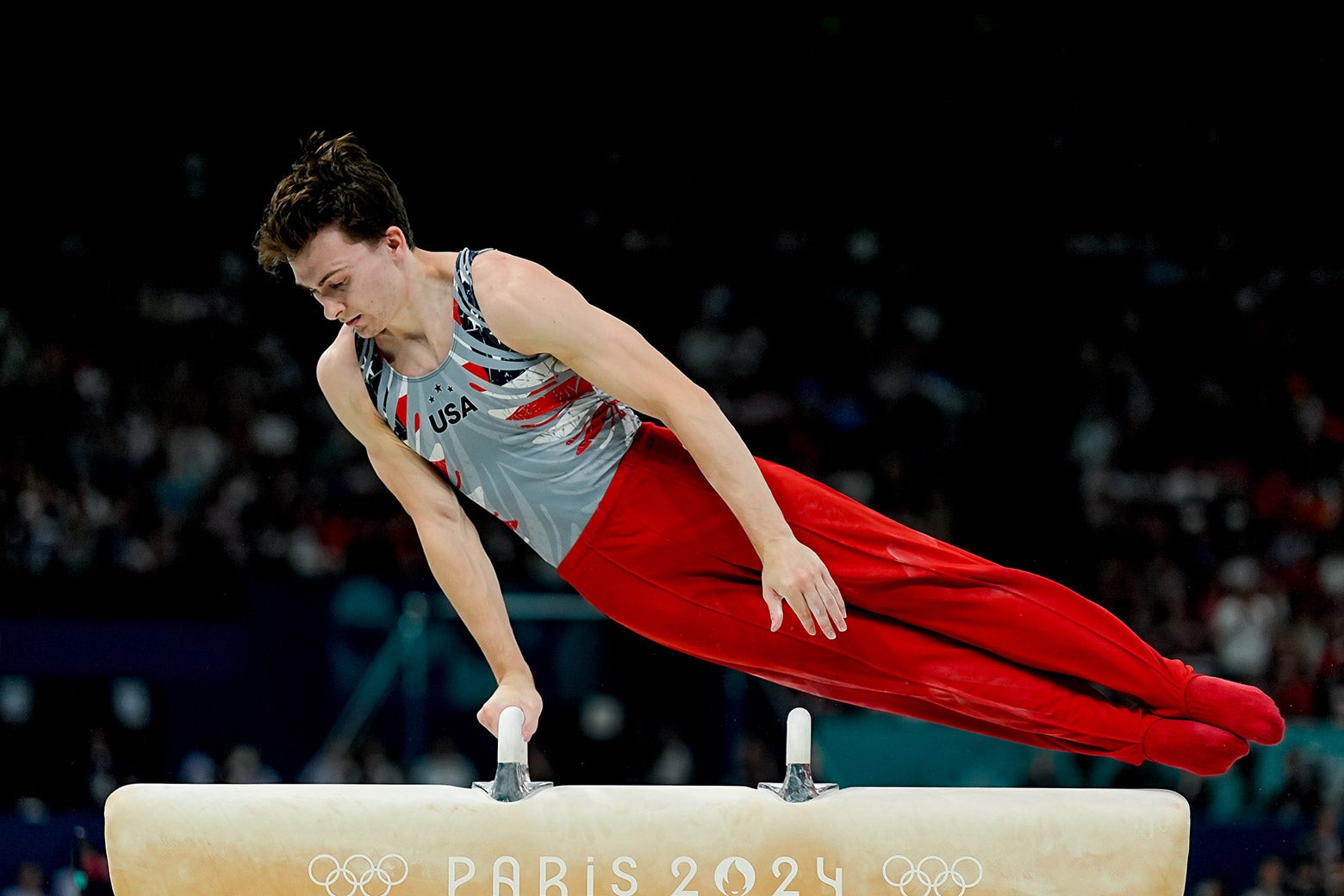
You know he’s about to stand on business when Stephen Nedoroscik takes off his glasses. The 25-year-old American gymnast, who trains and competes in precisely one of the six events in the sport of men’s artistic gymnastics, is in some ways the male answer to 2017 world champion Morgan Hurd, a bespectacled, chalk-covered hero. Unlike Hurd, however, who famously competes glasses-on, these days Nedoroscik pulls a full Kent-to-Superman: competing on muscle memory, instinct, feel, and pure, unadulterated American-grade will to power—vision be damned!
If this sounds abjectly bananas, you should probably know that Nedoroscik is one of the best pommel horse workers in the world. He also just helped put the Stars and Stripes on the medal podium in men’s gymnastics for the first time since Sarah Palin said she could see Russia from her house.
To appreciate the full extent of Nedoroscik’s most recent triumph—and that of his four teammates, Fred Richard, Paul Juda, Asher Hong, and Brody Malone—you should probably also understand the U.S. men’s program’s fraught history with this sport, given that it receives markedly less media attention than women’s artistic gymnastics does. (Yes, a sport where the “default” is the women’s version!)
Much like on the women’s side, the U.S. really didn’t have a medal-contending program (or any medal-contending athletes) until the late 1970s, when Kurt Thomas established himself as a one-man Uncle Sam juggernaut, walking away from the 1979 World Championships with six medals. Thomas also pioneered three skills, including a rollout tumbling skill that is now effectively banned across the sport (for falling-on-head reasons) and, most historically, what was once called the “Thomas flare” and is now so standard across the repertoire that it’s just a flare:
However, the Olympics in which Thomas had his best shot to medal were the 1980 Moscow Games, which the U.S. notably boycotted. And indeed, the first time in modern history the U.S. men ever did win a team medal was their gold in 1984. However, this was a gold-with-an-asterisk: The Los Angeles Games were revenge-boycotted by the USSR, whose program would have decimated anyone in its vicinity. Nevertheless, the Reagan-era Wheaties industrial complex managed to gloss over this fact enough to rocket the men to stardom (as it did on the women’s side, with Mary Lou Retton’s success). In some cases that stardom has lasted: ’84 stars Bart Conner and Tim Daggett have both been successful commentators for decades. (In the short term, both Conner and certified team hot guy Mitch Gaylord also parlayed their golden fame into brief, campy, but honestly delightful movie roles.)
By the 1988 Seoul Games, though, the U.S. resumed its usual place in the men’s canon: off the podium. In fact, between 1984 and 2001, not a single American man graced a world or Olympic medal stand. Between 2001 and 2008, it appeared the drought was over; this became especially true when Paul Hamm won all-around gold in Athens in 2004, and the team took away silver that year and bronze in Beijing four years later. But then the drought resumed.
Yes, there were numerous individual stars, a few individual medals, and team bronzes at World Championships in 2011 and 2014. But for the past three Olympics, the top three men’s teams (always Japan, China, and either Russia or Great Britain) have been untouchably good. In 2024, however, with even Shein Russia banned for who knows how long—a ban helped in no small part by the odious behavior of the team’s gymnasts—there has been a possible medal spot with the U.S.’s name on it. Not only that, but since 2020, the men’s program has been in an aggressive rebuilding phase and currently boasts a plethora of young talent. The program built this year’s Olympic team with a bronze medal in sight—and with some help from a disquieting if unsurprising source.
Just like for undergraduates writing papers and, I guess, someone’s daughter writing a “heartfelt” fan letter to her favorite hurdler, the program let A.I. do it. All right, that’s an oversimplification, but it did run all possible score scenarios (based on performance at Olympic trials) through an algorithm, and the team the algorithm picked was Malone, Juda, Hong, Richard, and Nedoroscik. Was it a good idea? When the U.S. team sustained numerous mistakes in qualifying on Saturday, I had my doubts. But when it came to Monday’s team finals, the numbers, in the end, didn’t lie.
And that brings us back to Nedoroscik and his one event. Using a precious five-man team slot for a single event specialist would, in most configurations, seem like a bad idea. And it would be a bad idea, except for the fact that Nedoroscik’s difficulty on pommels is very high. A difficulty value that high (in recent competitions, his start value can near the mid-to-high 16s, depending on what he decides to do) means a final score in or near those rare 15s—unless, of course, he falls. And I cannot emphasize enough how easy it is to fall off his event.
That possibility was at the center of this meet’s heart-pounding puzzle. I will admit that I had my doubts about this ChatGPT squad until the very last event they competed. Their placement in qualifying meant that they would end team finals on the single most brutal and nerve-destroying apparatus across all versions of gymnastics for time immemorial: that accursed pommel horse.
Do you get nervous watching gymnasts on the balance beam? Sure you do! But despite the beam’s formidable specs—4 inches wide; 4 feet off the ground—gymnasts at least get to pause in cute little poses between physics-defying acrobatic and dance elements, to gather themselves and right small wrongs. (When those cute little poses look a little wonky, they are usually unplanned; these are what your commentators will call a “wobble,” “bobble,” or “correction.”) So on beam, despite the terror-inducing flips and leaps, gymnasts are able to largely stop moving without technically stopping moving.
Do you know what you cannot do for a single microsecond on the pommel horse? Stop moving. In addition to the general coordination all gymnastics apparatuses require, this event demands simultaneous abdominal and upper-body might, massive cardio stamina, intricate rhythm, and total precision of hand placement. If a gymnast goes even the slightest bit off rhythm while circling or flaring around this Kafkaesque torture device, he’s cooked. In every other event in men’s and women’s gymnastics, it is not only possible but an everyday occurrence to use muscle to make a “save” (or prevent a fall). In pommels, this is straight-up impossible. I hate this event so much! Set it on fire!
Of course, if we set the pommel horse ablaze, that would mean there would be no Stephen Nedoroscik, and all time lines in this story lead back to this magnificent Weezer’s IT guy–looking dude. His four teammates all did more than their part on the first five events in the final: Stuck vaults! Solid rings! Great floor! Staying on the godforsaken high bar (second only to pommels on my kill list)! The bronze medal was suddenly very literally the U.S. team’s to lose—on the event where the literal best gymnasts the world has ever seen have choked.
Worse yet, because the U.S. would go last on pommels, and also because Nedoroscik was in the anchor spot, in order for the U.S. to clinch the bronze medal, he had to first sit in the arena with his glasses on and wait for almost three damn hours. (He was able to warm up a bit in the adjacent practice gym, but he got no more than the usual 30-second “touch” on the actual podium equipment.) As my colleague Dvora Meyers put it: “Watching the U.S. men on pommel horse in their final rotation may cause dry mouth, heart palpitations and sweaty palms. Speak to your doctor to see if watching pommels is right for you.” I can tell you: It is not.
But then, my friends! This happened.
He did it! They did it! Sixteen-year medal drought over! Shitty qualifying meet forgotten! United States of Beyoncé forever and ever, amen! The much more famous women’s team has called 2024 its “redemption tour,” but that group is not alone in its redemption. The men’s team final didn’t just redeem (for now) the use of A.I. in sports, or the gamble of putting a one-event specialist on an Olympic team, or even glasses wearers such as myself who are unable to use contacts (represent!). Most importantly, this medal has redeemed the U.S. men’s gymnastics program as world-class, because many of these guys are young and, health willing, you will see them on a medal podium again. Is it even possible that this team bronze will cause someone to, when I say I love “gymnastics,” ask Which gymnastics, men’s or women’s? Well, hold on there, bucko. I’m all for equal rights between the sexes, but let’s not get carried away.
