
Evolution of cars
•Download as ODP, PDF•
10 likes•10,527 views
The document summarizes the evolution of cars from their origins to modern electric vehicles. It describes the first car built by Nicholas Joseph Cugnot in 1769, the first gas-powered car invented by Karl Benz in 1885, and Henry Ford's improvements to the assembly line which made cars more affordable. It also outlines key developments such as the integration of steel bodies in 1914, radios in the 1920s, and air conditioning in 1939. The document concludes by discussing the rise of electric vehicles as gas prices have increased and government support for next generation electric cars.
Report
Share
Related slideshows
Report
Share

More Related Content
What's hot
Automobile History
Daimler designed the first four-wheeled automobile in the late 1800s. Karl Benz is credited with building the first automobile powered by an internal combustion engine in 1885. Throughout the early 20th century, automobiles continued to evolve with improvements like synchronized transmissions, braking systems, and new materials. By the late 20th century, computer technology began to be used more in automobiles to control systems like anti-lock brakes and GPS navigation. Today's cars are increasingly computerized and made with lightweight but strong materials.
History of automobile
The document summarizes the history and development of automobiles from the first steam-powered car built by Joseph Cugnot in 1769 to modern cars with computer-controlled systems. It notes key developments like the first internal combustion engine (Jean Joseph Étienne Lenoir), four-cylinder engine (Nikolaus August Otto), four-wheeled automobile (Gottlieb Daimler), and Model T (Henry Ford). Over time, cars gained new technologies, styles evolved between World Wars, and computer chips now control many systems. Top modern brands include Toyota, Volkswagen, Mercedes, and BMW.
Evolution of cars
The document summarizes the evolution of cars from early designs in the 1300s to modern times. It describes key developments like the first internal combustion engine in the 1800s, the first vehicle to move under its own power in 1769, early experiments with fuels like gunpowder and coal gas, and innovations like the gasoline engine, hybrid vehicles, fuel injection, catalytic converters, and fuel cells. It traces the transition from steam and gas power to gasoline and highlights early pioneers and models like the Model T that helped popularize automobiles.
Automobile history
The document summarizes the history of automobiles from their origins in the late 18th century to modern developments. It notes that Karl Benz is considered one of the founders of Mercedes-Benz and built the first automobile powered by an internal combustion engine in 1885. It then outlines key developments over the 20th century like the introduction of synchronized transmissions, braking systems, and new materials. The document concludes that computers now control many vehicle systems and autonomous vehicles may be the future of transportation.
Automobiles
The document provides a history of the automobile starting with early steam-powered vehicles in the 1600s and crediting Karl Benz with inventing the modern automobile in 1885. It discusses Henry Ford's introduction of the Model T and assembly line production, which revolutionized transportation. The document also covers fuel and propulsion technologies including gasoline, diesel, electric, hybrid, and alternative fuels. It concludes with benefits of automobiles and their major environmental impacts.
Automobile seminar
Mr. Kamble Sagar presented on the history, evolution, and future of automobiles. The document discussed the early history of automobiles from steam-powered vehicles in the 17th century to Karl Benz's gas-powered Motorwagen in 1885. It covered the types of engines used in cars from gasoline and diesel to future technologies like electric, hydrogen, and air-powered engines. The document concluded with a discussion of innovations in automobiles including hybrids, hypercars, ultra-light cars, and self-driving vehicles.
Evan's PPT on Who made the first car
The first self-propelled vehicle was invented in 1769 by Nicolas Joseph Cugnot and was powered by steam. It traveled at speeds between 12-21 mph but had to stop every 10-15 minutes to build up steam. The Borodino steam carriage, introduced later, resembled a horse-drawn carriage but had a steam engine in the back. The internal combustion engine, invented by Belgian Etienne Lenoir, did not require waiting for steam and made starting a vehicle quicker. Carl Benz and Gotlieb Daimler helped popularize the combustion engine in the 1880s. Early cars resembled horse-drawn carriages and were called "horseless carriages." They were hand-built, expensive
Evolution of a Product:Car
The document summarizes the evolution and life cycle of cars from their invention to modern times. It describes key developments in early steam-powered vehicles in the late 18th century, followed by gasoline-powered cars in the late 19th century pioneered by Karl Benz. Henry Ford later revolutionized car production with the assembly line in the early 20th century. The document then outlines the various stages in a car's life cycle from raw material extraction and assembly to consumer use, repair, and eventual recycling of parts at the end of its life.
Flying Cars
The document provides an overview of flying cars, both past attempts and current/future developments. It discusses the history of early flying cars from the 1910s-1940s that were prototypes but not viable options. It then focuses on the Transition, a modern flying car created by Terrafugia that can drive on roads and fly, though it requires a pilot's license and airport runway. Finally, it outlines Terrafugia's vision for the TF-X, a future autonomous flying car that could be operated with minimal training and takeoff/land anywhere.
Cars
1) A car is a motor vehicle used for transporting passengers that carries its own engine. Most have seating for 1-8 people and 4 wheels.
2) The words "automobile" and "car" originate from ancient Greek and Latin terms meaning a self-moving vehicle.
3) The first working automobile was invented in 1769 by Nicolas Joseph Cugnot, who built a steam-powered tricycle in France. However, steam power had limitations and gasoline engines were developed, leading to widespread automobile use in the late 19th century.
History of cars presentation
Cars have evolved significantly over time. Originally, cars were designed primarily for transporting passengers and had engines, seating for 1-8 people, and four wheels. In the early 20th century, cars started being mass produced using assembly lines, bringing the cost down and making them more accessible. As technology advanced in the late 20th and early 21st centuries, features like automatic transmission, anti-lock brakes, airbags, and automatic climate control were incorporated into car design. Today hybrid electric vehicles that combine a gasoline engine and electric motor such as the Toyota Prius are increasingly popular alternatives to traditional petroleum-powered cars, while some electric cars are powered entirely by on-board batteries.
Electric Cars
Electric vehicles first gained popularity in the late 19th century as battery technology advanced, allowing for higher speeds. By the early 20th century, electric vehicles were more popular than gas-powered cars due to their reliability. However, as the price of electric cars increased and fossil fuels became cheaper, gas vehicles rose in demand. Interest in electric vehicles renewed in recent decades due to higher gas prices and environmental regulations. Now, battery technology provides electric vehicles with ranges over 200 miles, and many major automakers are producing electric car models as their popularity continues to grow.
Timeline Of Cars
The document provides a brief timeline of important developments in cars from 1769 to 1997. It describes the first car built by Nicolas Cugnot in 1769, the first practical automobile built by Karl Benz in 1885, Wilhelm Maybach building the first 4-cylinder engine in 1890. It then discusses Henry Ford's moving assembly line allowing for mass production of affordable Model T cars in 1913, cars developed during World War II, the muscle car era of the 1960s, the 1973 oil crisis, and the introduction of the Toyota Prius hybrid electric vehicle in 1997.
Hybrid cars
This document provides an overview of hybrid vehicles, including their history and evolution. It discusses how hybrids work by combining an internal combustion engine with an electric motor powered by batteries. The document outlines the components of hybrid vehicles and explains the benefits of hybrids such as improved fuel efficiency and reduced emissions compared to conventional vehicles. Both the advantages and disadvantages of hybrid technology are presented.
Historia del automóvil
El documento resume la historia del automóvil desde su creación en 1769 hasta la actualidad. Algunos de los hitos más importantes incluyen la creación del primer auto a vapor en 1769, el desarrollo del freno de mano y otras innovaciones en 1784, la creación del primer auto eléctrico en 1881, y el desarrollo del primer motor a gasolina en 1883. A lo largo del siglo XX, se desarrollaron muchas marcas automotrices importantes como Benz, Renault, FIAT, Chrysler y Honda, y se introdujeron innovaciones como el
The Electric Car
The document discusses the history and current state of electric vehicles. It describes how in 2002, major car companies raced to create the first popular electric car. While Robert Anderson invented the first electric carriage in 1834, modern companies have created around 30 moderately efficient electric car models. The electric car uses a battery to power an electric motor and provide fast, clean transportation for short distances, though they have limitations such as limited range and high costs compared to gas cars. Companies predict that electric cars will be improved by 2035.
Hybrid cars
The document is about hybrid vehicles and includes sections on their introduction, working, regenerative braking, history, present state, pros and cons, and future scope. It defines hybrid vehicles as those combining an internal combustion engine with an electric motor. The history section outlines some of the early developments of hybrid vehicles dating back to the late 1800s. It also discusses some of the major automakers now producing hybrid models and their benefits including increased efficiency and reduced emissions.
Electric vehicles
An EV is a shortened acronym for an electric vehicle. EVs are vehicles that are either partially or fully powered on electric power. Electric vehicles have low running costs as they have fewer moving parts for maintenance and also very environmentally friendly as they use little or no fossil fuels (petrol or diesel).
An Introduction To Electric vehicles
A brief introduction to the benefits of electric vehicles and how they are now becoming part of particular industries. GLH is a leading London Private Car Hire company. www.glh.co.uk
EVOLUCIÓN DEL AUTOMOVIL
Este documento resume brevemente la historia del desarrollo del automóvil desde su creación en 1769 por Nicolas-Joseph Cugnot hasta el año 2000. Detalla algunos de los hitos más importantes como el primer motor de gasolina en 1883, el primer vehículo de serie con neumáticos en 1895, el primer automóvil de Henry Ford en 1896, y la introducción de nuevas tecnologías como los airbags en 1988 y los vehículos híbridos en 2000.
What's hot (20)
Viewers also liked
Presentation1
Cars have evolved significantly from the 1960s to present day. Early cars from the 1960s were basic but became more advanced each decade with new technologies and designs. Modern cars from the 2000s and beyond are highly sophisticated with computerized driving systems, advanced safety features, and powerful yet fuel efficient engines.
The evolution of medicine: DNA
This document summarizes and comments on three scientific articles about recent discoveries related to DNA regulation and replication. The first article discusses a discovery about how metabolism is linked to epigenetic regulation of DNA through an enzyme that transfers acetyl groups. The second article discusses reconstituting the DNA replication fork to study its process and regulation. The third discusses the medical importance of understanding DNA replication and regulation to develop new disease treatments.
The evolution of cellphone
The document traces the evolution of mobile phones from 1973 to 2015, beginning with early Motorola cell phones in the 1980s that were large and expensive, to the first smartphones by IBM and BellSouth in 1993. It highlights several important models through the decades that advanced features like touchscreens, apps, and cameras. These include the Motorola StarTAC in 1996 as the first clamshell phone, the Nokia 8210 and 5110 that popularized customization, and the iconic Motorola Razr in 2004. The document concludes that the 2007 Apple iPhone revolutionized the industry by establishing the modern smartphone format.
Ashleymg.pptx
El documento habla sobre la ciudad del amor, París. Menciona que incluye secciones sobre qué ciudad es, lugares a visitar como la Torre Eiffel y otras atracciones, tradiciones culturales, y una conclusión donde se describe a París como la ciudad más romántica de Europa y la Torre Eiffel como el monumento más visitado del mundo. El documento también incluye imágenes y créditos de licencias.
Objects in space
Comets are balls of frozen water, dust and gases that develop distinctive tails when heated by the Sun. They have four parts: the solid nucleus at the center, surrounded by a coma of gas and dust, with two tails - one of dust and one made of ionized gases. Asteroids are smaller rocky objects that orbit the Sun, many located in the asteroid belt between Mars and Jupiter. Large asteroids and comets have struck Earth in the past, including one hypothesized to have caused the extinction of the dinosaurs. Meteoroids are space rocks that burn up as meteors in Earth's atmosphere, with larger ones surviving to impact as meteorites. Moons orbit planets and range widely in size, composition and volcanic activity
Mi Hijo Es Rechazado Por Sus CompanyEros
Este documento trata sobre el tema del rechazo entre iguales. Explica qué es el rechazo entre iguales, por qué se da este fenómeno, cómo detectarlo e intervenir. Ofrece indicadores para identificar a un alumno rechazado y las consecuencias negativas que puede tener el rechazo. Además, proporciona recomendaciones para profesores, alumnos y padres sobre cómo abordar este problema.
The Future of Electric Vehicles in Australia - EVC Char Behyad Jafari
This document discusses the path forward for electric vehicles in Australia. It outlines some of the barriers to electric vehicle uptake in Australia, such as high upfront costs and lack of model availability. It also shows that global electric vehicle sales are growing rapidly at 60-70% per year, while Australian sales are lagging behind. The document proposes several policy options to support electric vehicle adoption in Australia, such as incentives for consumers and fleets, infrastructure investment, and raising awareness of electric vehicles.
How A Great Leader SHAPES Others
The slide deck I used when I spoke to the staff at Camp Rockmont. The topic is about how a great leader SHAPES those around them. SHAPES is an acronym for: Serves, Holds ground, Acts, Prepares, Empowers, Speaks. I believe this holds true for any leader in a personal service field.
Idiomas presentation
Este documento trata sobre los idiomas y su función. Existen más de 6,000 idiomas en todo el mundo que sirven para comunicarse entre países y regiones. Algunos de los idiomas más hablados son el inglés, español y varios idiomas asiáticos. Sin los idiomas no sería posible la comunicación entre personas de diferentes lugares.
El Uso del Internet en la Educación
El documento describe el uso de Internet en la educación. Explica que Internet es un sistema de redes interconectadas que ofrece diversos servicios y recursos útiles para la educación como bibliotecas, imprentas y medios de comunicación. Además, destaca que el uso de Internet en la educación fomenta la independencia y autonomía del alumnado al darles acceso a numerosas posibilidades educativas. Finalmente, señala algunas aplicaciones educativas de Internet como la preparación de clases, documentación de trabajos y comunicación entre estudiantes.
Education system in india
Sarvottam International School was founded over 60 years ago by the United Group, an industrial house involved in manufacturing kitchenware. The school's motto is "Belonging - Being - Becoming" which focuses on strengthening bonds within the global community and emphasizing personal growth and change. Sarvottam provides excellence in education from primary to higher levels. It also focuses on vocational training to help students find careers. While India has made efforts to provide education for all, challenges remain in achieving universal literacy, with rural areas and girls facing greater barriers. Sarvottam aims to empower students socially, morally and ethically through a focus on quality education.
Key Traits That Define A CEO as A Great Leader
The title CEO is more than just the three letters. A CEO with great leadership skills should understand every aspect of the business, have knowledge of the industry, make good decisions and form deep relationships with his team.
Corea del sur
Corea del Sur se encuentra en la península de Corea y limita al norte con Corea del Norte. La bandera nacional se llama Taegeukgi y representa los principios del yin y el yang. Las principales ciudades son Seúl, Busan, Incheon, Daegu y Daejeon. El país tiene cuatro estaciones y montañas como el monte Baekdu. Los ríos principales son el Amnok, Duman y Hangang. Los recursos turísticos incluyen el puente Banpo y el templo budista Bongeunsa.
10 Reasons to Smile
This document lists 12 reasons to smile, including that smiling makes you more attractive, improves your mood, is contagious, relieves stress, boosts the immune system, lowers blood pressure, releases endorphins, lifts the face and makes you look younger, makes you seem successful, and helps you stay positive. Smiling provides both psychological and physical health benefits.
Astrologia
El documento resume la importancia de la astrología, explicando que estudia la relación entre los movimientos celestes y los eventos terrenales. Argumenta que la astrología puede ayudar a las personas a elegir mejor su camino de vida identificando pruebas y recibiendo consejos para evolucionar espiritualmente. Finalmente, sugiere que leer el horóscopo puede ser un entretenimiento inteligente si se interpreta de manera personal.
Barista 1
Un barista es un experto en la preparación de café espresso que requiere conocimientos sobre los tipos y calidad del café, el molido, la temperatura de la máquina y el proceso de tampado y extracción. La preparación del espresso perfecto depende de varios factores como la presión al tampar, la frescura y cantidad del café, el tiempo de extracción y la limpieza de la máquina. Además de espresso, un barista puede preparar otras bebidas como cappuccino, americano y frappuccino.
Puerto rico, una pequeña tierra con grandes
Puerto Rico es una isla con una rica cultura y tradiciones. El idioma oficial es el español, aunque también se habla inglés. La música folclórica incluye bomba, plena y salsa. Algunos artistas y escritores puertorriqueños notables son Ricky Martin, Calle 13, Ana Lydia Vega y René Márquez. La gastronomía y artesanía también son parte integral de la cultura, con platos como el mofongo y artesanías como las plumas pintadas y el cuatro puertorriqueño. Puerto Rico
Thanairy
Corea del Norte es un país con una historia, cultura y costumbres únicas. No tiene acceso a Internet, su economía es planificada por el estado y no permite la publicidad. A pesar de estas restricciones, Corea del Norte mantiene su propia identidad cultural distintiva.
Pronouns slurs etc
Pronouns are words that substitute for nouns and can refer to people, places, or objects. Common English pronouns include they, them, he, and she. The document discusses gender neutral pronouns and terms commonly used in the transgender community such as MTF, FTM, transgender, and transsexual. It provides definitions for these terms and advises asking for someone's preferred pronoun rather than making assumptions. The best way to stay informed is by joining social media groups on gender topics since understanding of gender is continually evolving.
Education system in India
Education in India is controlled by the Human Resource Department and conducted through public and private sectors. Literacy rates are growing as more children, especially girls, are attending school starting at ages 3-4 through various government schemes that encourage female education. Primary education focuses on basic learning for children, secondary education is a more specialized stage, and higher education includes graduation and post-graduation programs. Primary and secondary education are overseen by state boards and national examinations.
Viewers also liked (20)
The Future of Electric Vehicles in Australia - EVC Char Behyad Jafari
The Future of Electric Vehicles in Australia - EVC Char Behyad Jafari
Similar to Evolution of cars
HistoryofFrenchautomobiles.ppt
The document provides a history of French automobiles, beginning with early designs for steam-powered and internal combustion engine vehicles in the late 18th and 19th centuries. It discusses Nicolas Cugnot building the first self-powered road vehicle in 1769 in France. Gottlieb Daimler and Karl Benz are credited with inventing practical gasoline-powered automobiles in the 1880s in Germany. The document then summarizes the evolution of automobile technology and highlights several important early French automobile manufacturers and models, including Peugeot, Citroen, Renault, and Bugatti.
HistoryofFrenchautomobiles (1).ppt
The document provides a history of French automobiles, beginning with early designs for steam-powered vehicles in the late 18th century. It discusses Nicolas Cugnot building the first self-propelled vehicle in 1769. Gottlieb Daimler and Karl Benz are credited with inventing gasoline-powered automobiles in the 1880s. The document then covers the evolution of automobile technology and early manufacturers like Peugeot, Citroen, and Renault. It provides details on iconic French cars like the Citroen 2CV and Traction Avant. The last sections discuss Ettore Bugatti and the founding of the Bugatti brand, as well as some of their pioneering racing vehicles and the modern Veyron.
historyofautomobile-131222033601-phpapp01 (1).pptx
The document traces the history and development of automobiles from the first steam-powered car built by Joseph Cugnot in 1769 to modern hybrid and electric vehicles. Some key developments included Karl Benz building the first internal combustion engine car in 1885, Henry Ford developing assembly line manufacturing making cars more affordable, and computer chips now controlling most car systems. Top car manufacturers today include Toyota, Volkswagen, and Mercedes-Benz while top luxury brands are Rolls-Royce, Bentley, Ferrari and Lamborghini.
HISTORIA DOS CARROS.pptx
Cars have evolved tremendously since their invention in the late 18th century. The first self-propelled vehicle was invented in 1769 by Nicolas-Joseph Cugnot and used a steam engine. In the late 19th century, gasoline and electric engines were developed bringing about the first modern automobiles. Henry Ford later revolutionized the industry with the inexpensive, versatile Model T in 1908 which made cars accessible to the masses. Throughout the 20th century, automotive technology advanced greatly with new features improving performance, safety and comfort. Looking ahead, future innovations are expected to continue enhancing the automobile experience.
CAR HİSTORY BY BİG BOSS
The document summarizes the history and development of automobiles. It describes how the first self-propelled vehicles were invented in the late 18th century in France. In the late 19th century, gasoline-powered engines were developed and cars became popular recreational vehicles for the wealthy. Henry Ford later invented the affordable Model T in 1908, making cars accessible to the masses. Throughout the 20th century, automotive technology advanced with new features such as automatic transmissions, airbags, and computer-assisted driving systems.
My work deals with automobile
This document provides a history of the automobile from its origins in China in the late 17th century to modern developments. It discusses early steam-powered vehicles, the invention of the gasoline-powered automobile by Karl Benz in 1886, and the mass production of automobiles through companies like Ford in the early 20th century. The document also covers the materials used in automobile construction over time and important safety innovations like anti-lock brakes.
Transports - Cars
1) The document discusses the history of cars from early steam-powered vehicles in the 1700s to the development of gasoline-powered combustion engines and mass production in the late 1800s and early 1900s.
2) It notes key events like Karl Benz inventing the first gasoline-powered car in 1886 and Henry Ford developing the Model T for mass production.
3) The final section covers advantages and disadvantages of car usage, noting they provide convenience and speed but require money, cause pollution, and can lead to accidents.
Automobile
The document traces the history and development of cars from their earliest origins to modern times. It discusses the first wind-powered vehicle invented in 1335, followed by the first steam-powered vehicle invented by Nicolas Joseph Cugnot in 1769. Electric vehicles were also an early focus, with the first electric carriage invented in 1832. Internal combustion engines were subsequently developed, starting with Christian Huygens' gunpowder design in 1680 and culminating in Daimler's four-stroke gasoline engine in the late 1800s. The gasoline car went on to outsell other vehicle types in the early 1900s, with early manufacturers including Panhard & Levassor, Peugeot, and RansomeEli Olds'
Cars
The history of automotive vehicles began in the 18th century with steam-powered cars. Early attempts to build self-propelled vehicles used steam, electricity, and gasoline as means of propulsion. The first true steam-powered car was built in 1769 by Nicholas Cugnot, but it was too heavy and noisy. In the following decades, inventors experimented with steam, electric, and gasoline engines to power early automobile prototypes. The first successful gasoline-powered automobile, the Benz Patent-Motorwagen, was invented in 1886 by Karl Benz. Mass production of automobiles began in the late 19th century in both France and the United States, establishing the world's first automobile companies.
history-of-automobile.ppt
The first three sentences summarize the key developments in early automobile history:
The first car was built by Joseph Cugnot in 1769 and was powered by a steam engine. Jean Joseph Étienne Lenoir built the first internal combustion engine in the 1860s. Karl Benz is credited with building the first automobile powered by an internal combustion engine in 1885.
History of automobile
The early history of the automobile saw experimentation with various propulsion methods including steam, electricity, and internal combustion engines using gases and liquids as fuels. Nicolas-Joseph Cugnot is considered by some to have built the first self-propelled mechanical vehicle in 1769 powered by a steam engine. Karl Benz developed and produced the first automobile recognized as such in 1885, powered by an internal combustion engine using gasoline. Henry Ford's Model T, first produced in 1908, was the first automobile mass-produced on moving assembly lines, making automobiles affordable for the masses.
A.presentation1 ray111
Nicolas-Joseph Cugnot built the first self-propelled mechanical vehicle in 1769. Rudolf Diesel developed the compression ignition engine in the late 19th century. The first practical petrol engine was built by Nikolaus Otto in 1876. Karl Benz received a patent for the first practical motorcar, powered by a petrol engine, in 1886. In the early 20th century, hybrid vehicles began to emerge, combining petrol engines with electric motors. Automotive technology has since focused on improving comfort, safety, and value for humans.
The history of automobile where they start
The development of the automobile began in the late 17th century with early steam-powered vehicles and the first steam-powered car built in 1769. In the early 19th century, inventors created some of the first internal combustion engines and electric motors to power cars. The first modern, practical automobile for everyday use appeared in 1886 when Carl Benz developed a gasoline-powered car and began mass production. In the late 19th and early 20th centuries, many inventors and companies, including Oldsmobile and Ford, further advanced automotive technology and pioneered assembly line production, making cars more widely available and affordable to the public.
La petit histoire de l'autromobile
This document provides a history of the automobile from its origins in the late 18th century to modern times. It traces the key developments over time, including some of the earliest steam-powered vehicles in the 1700s; Karl Benz's patent of the first gasoline-powered automobile in 1886; the establishment of commercial automobile companies like Panhard et Levassor, Peugeot, and Renault in the late 1800s; the rise of Ford and its Model T in the early 1900s; and advances in the mid-20th century like front-wheel drive with the Citroen Traction Avant and the mass popularity of cars like the Volkswagen Beetle and Fiat 500. The document covers major innovations and
Automobile history
The document provides a detailed history of the automobile from its early origins to modern developments. It discusses key milestones and inventors including:
- The first self-propelled road vehicle in 1769 powered by a steam engine. Early vehicles relied on steam power but were inefficient.
- Inventors in the late 1800s who developed early gasoline and diesel internal combustion engines, including Nikolaus Otto's 1876 four-stroke engine and Gottlieb Daimler and Wilhelm Maybach's 1885 vertical cylinder engine with a carburetor.
- Karl Benz's 1885 patent for the first practical three-wheeled automobile and his later four-wheeled designs in the 1880s, considered the first modern
Automobile History for Engineering Students
The document provides a detailed history of the automobile from its early origins to modern developments. It discusses key milestones and inventors including:
- The first self-propelled road vehicle in 1769 powered by a steam engine. Early vehicles relied on steam power but were inefficient.
- Inventors in the late 1800s who developed early gasoline and diesel internal combustion engines, including Nikolaus Otto's 1876 four-stroke engine and Gottlieb Daimler and Wilhelm Maybach's 1885 vertical cylinder engine with a carburetor.
- Karl Benz's 1885 patent for the first practical three-wheeled automobile and his later four-wheeled designs in the 1880s, considered the first modern
Auto handout unit 1 history
The document provides a detailed history of the automobile from its early origins to modern developments. It discusses key milestones and inventors including:
- The first self-propelled road vehicle in 1769 powered by a steam engine. Early vehicles relied on steam power but were inefficient.
- Inventors in the late 1800s who developed early gasoline and diesel internal combustion engines, including Gottlieb Daimler and Karl Benz who are credited with creating the first modern gasoline-powered automobiles.
- Henry Ford's innovations with the assembly line in 1913 which reduced production costs and made automobiles affordable for the masses with the Model T, selling over 15 million units.
- Important models like the
20100454 cemal kesanli
Several early inventors designed steam and gasoline powered vehicles in the late 18th and 19th centuries. Gottlieb Daimler built a wooden motorcycle in 1885. Karl Benz drove his gasoline-powered tricycle in 1885. Charles and Frank Duryea built the first successful gasoline-powered car in America in 1893. Their single-cylinder, 4 HP car with friction transmission and low-tension ignition was driven on public roads in Massachusetts. Early vehicles struggled with reliability and practicality issues on roads until advances like the internal combustion engine and gasoline fuel made automobiles more viable.
HISTORY OF AUTOMOBILE.pptx
The development of the automobile began in the late 17th century. Steam power was an early attempt at portable power but internal combustion engines eventually proved more practical. The first internal combustion engine automobile was built in 1885 by Karl Benz. Henry Ford's assembly line techniques helped the Model T become the first affordable automobile for mass consumption in the early 20th century. Modern features like power steering, air conditioning, and electronics have since been incorporated to enhance comfort, safety and navigation.
Automotive project 9th.pptx
The development of the automobile began in the late 17th century. Steam power was an early attempt at portable power but internal combustion engines eventually proved more practical. The first internal combustion engine automobile was built in 1885 by Karl Benz. Henry Ford's assembly line techniques led to mass production of affordable cars in the early 1900s. Key developments included electric starters, power steering, headlights, radiators, air conditioning, differentials, radios, and navigation systems to produce the modern automobile.
Similar to Evolution of cars (20)
historyofautomobile-131222033601-phpapp01 (1).pptx
historyofautomobile-131222033601-phpapp01 (1).pptx
More from scitch117
8th Science Slide
God created all matter and the elements. He arranged them in an orderly pattern, like the Periodic Table, and gave each unique properties. God also gave us energy and the ability to understand forces and motion. Jesus is the light that guides us, just as light guides our understanding of the physical world. Throughout science, we can see God's design and fingerprints on his creation.
8th grade science bible integration
This document provides a summary of 8th grade science concepts with biblical integration. It covers topics like matter, atoms and the periodic table, chemical bonds, chemical reactions, acids and bases, energy, thermal energy, motion, forces, electricity, sound, and light. For each topic, it lists 3-4 key points and relates them to a bible verse, with the overarching message that God created an orderly system and wants Christians to use their understanding of it to better know and serve him.
8th Grade Science Review Bible Integration
God created all things, including matter and energy. The document provides a summary of key concepts from 8th grade science, with biblical verses integrated throughout. It covers topics like the states of matter, atoms and the periodic table, chemical bonds and reactions, acids and bases, forms of energy, motion, forces, magnetism, electricity, sound, and light. The summaries highlight that all things were made by God and that science reveals aspects of his creation and power.
Jordan biblical Integration
This document provides a summary of 8th grade science topics from a biblical perspective. Each topic includes 1-3 bible verses that relate to the science concepts and 3-5 bullet points summarizing the key ideas. The topics covered include matter, atoms and the periodic table, chemical bonds, chemical reactions, acids and bases, energy, thermal energy, motion, forces, magnetism, electricity, sound, and light.
8th larry
This document provides a summary of key science concepts related to matter, atoms, chemical bonds, reactions, acids and bases, energy, motion, forces, magnetism, electricity, sound, and light. Each section includes a Bible verse and brief explanation of how it relates to the science topic. The concepts are defined concisely, such as the three states of matter, atomic structure, types of chemical bonds and energy, forms of motion, types of forces, properties of magnets and electricity, characteristics of sound and light waves.
8th grade science jb
This document contains a summary of key concepts from an 8th grade science textbook organized by topic. The topics covered include matter, atoms and the periodic table, chemical bonds, chemical reactions, acids and bases, energy, thermal energy, motion, forces, magnetism, electricity, sound, and light. For each topic, there is a brief 1-2 sentence definition or description of the science concept and it is related to a Bible verse.
Fireworks Michael and Matthew
The document describes the anatomy, history, and chemistry of fireworks. It explains that fireworks work by using black powder to launch shells into the air, where a secondary fuse then ignites stars that explode and produce colorful patterns. Fireworks were invented in China by monks mixing saltpeter, sulfur, and charcoal to produce the first rockets. The document provides safety tips and lists different chemical elements that burn specific colors when used in fireworks.
Fire works from ben
Fireworks contain black powder, fuses, and colored elements that produce different colors when burned. Chemical reactions occur when compounds are mixed with black powder to create stars of different colors - yellow comes from sodium, orange from calcium, red from strontium, green from barium, and blue or purple from copper or strontium. Fireworks were invented in China over 1,000 years ago using black powder made from saltpeter, sulfur, and charcoal. They have since been used in celebrations and displays around the world. Safety tips recommend wearing ear protection and keeping a safe distance from fireworks.
Fireworks s.a.j
This document discusses the history, components, chemistry, and safety of fireworks. It explains that fireworks produce color through the combustion of different metal elements and compounds. Lithium makes red, sodium makes gold and yellow, and barium makes green. The history section notes that the Chinese used black powder over 1000 years ago and that fireworks were used against Mongol invaders in 1279. The document provides safety tips, advising leaving fireworks to professionals and taking reasonable precautions to avoid injuries.
Fireworks Kristin Rj
Fireworks contain a shell, fuse, gunpowder, and stars made of chemicals that produce different colors when burned. Stars are made by mixing chemicals with paste and forming them into balls. The fuse ignites the gunpowder, which explodes and sends the stars into the sky. Common chemicals that make colors include copper for blue, barium for green, and lithium or strontium for red. Fireworks were first invented in China using gunpowder and have been used for entertainment for centuries. Safety tips recommend keeping a distance from fireworks and not approaching any that have not ignited.
Fireworks amn
The document discusses the parts, chemical reactions, and history of fireworks. It describes the main components of fireworks like the black powder fuse, bursting charge, and break. The chemical reaction involves adding raw materials, igniting an energy source to start the reaction, and using the fuse to light the black powder and cause the firework to explode. Different chemical compounds produce different colors when burned. The history section notes that fireworks originated in China and were brought to Italy by Marco Polo. Safety tips recommend having a designated shooter, only using fireworks outdoors, and being prepared with water and safety glasses.
fireworks Imani Josh
Fireworks contain various chemical compounds that produce different colors when burned. Parts of a firework include a break, time delay fuse, and stars that explode separately. A firework is propelled into the air by a lift charge after the fuse ignites black powder in the launching tube. Chemical reactions between substances like potassium chlorate and gunpowder produce heat and light. Common firework designs include palms, chrysanthemums, and roundels. The Chinese invented fireworks over 1000 years ago to scare spirits, and they have since evolved with many technological and safety improvements.
Klinefelter Syndrome HRB.
Kline Felter Syndrome is a genetic disorder where males are born with an extra X chromosome, resulting in XXY sex chromosomes. It occurs due to a random error in the mother and father's sex cells when the baby is conceived. Signs include a taller and less muscular body type, broader hips, larger breasts, weaker bones, and smaller genitals. It can cause learning problems and issues with sexual development or infertility. While there is no cure, treatments can help address symptoms.
Muscular dystrophy ld
Muscular dystrophy is a genetic disorder that causes progressive weakening and loss of muscle mass. It affects muscles that help the body move and can also impact posture and breathing. The disorder is caused by missing or incorrect information in genes or a damaged X chromosome. While there is no cure for muscular dystrophy, treatments like therapy and surgery can help reduce pain. DNA testing allows people to be prepared, but the condition cannot be prevented.
Down's syndrome lm
Down's Syndrome is a genetic disorder caused by the presence of an extra chromosome 21, known as trisomy 21. It is characterized by physical effects like upward slanted eyes, a flat nose, a small head, and short stubby hands. Individuals with Down's Syndrome are also more likely to have heart defects and lung infections. Treatments include medication, surgery to correct issues, proper education and care, and speech or physical therapy. Diagnosis is suggested for mothers over 35 and can be confirmed through blood tests, ultrasounds, or by checking chromosomes.
Gb turner syndrome
Turner Syndrome is a genetic condition that affects development in females and is caused by the absence of one X chromosome. The effects at birth can include swollen hands, feet, and face. While there is no prevention or cure, doctors can test for it at birth through a karyotype and monitor development. Those with Turner Syndrome are typically shorter in height and may struggle with fertility, though pregnancy is possible with medical intervention.
Optic atrophy sa
Optic atrophy is caused by mutations in the OPA1 gene and is inherited in an autosomal dominant pattern. It causes progressive vision loss that typically begins in the first decade of life by inflaming the optic nerve. While optic atrophy itself is not curable and damage to the optic nerve cannot be reversed, an early diagnosis may help prevent further vision loss if the underlying cause can be identified and corrected. Optic atrophy occurs most commonly in Denmark, affecting 1 in 10,000 people there.
Hemophilia jordan
Hemophilia is a genetic bleeding disorder caused by a defective gene on the X chromosome. People with hemophilia bleed excessively from minor cuts or bruises since their blood does not clot normally due to a missing clotting factor. While there is no cure, treatment involves replacing the missing clotting factor through injections to control bleeding. Hemophilia can be diagnosed through genetic testing and occurs in two main types, with Hemophilia A being more common.
Gb turner syndrome
Turner Syndrome is a genetic condition that affects development in females and is caused by the absence of one X chromosome. The effects at birth can include swollen hands, feet, and face. While there is no prevention or cure, doctors can test for it at birth through a karyotype and monitor development. Those with Turner Syndrome are typically shorter in height and may struggle with fertility, though pregnancy is possible with medical intervention.
Albinismbj
Albinism is a genetic condition caused by a lack of melanin pigment, resulting in white hair, pale skin, and vision problems. Both parents must carry the albinism gene for a child to inherit it. Those with albinism typically have white hair, blue or gray eyes with poor vision, milky white skin, and sensitivity to light. Treatments include wearing sunscreen, sunglasses, prescription lenses, eye surgery, and regular eye exams. While there is no prevention or cure, with proper care those with albinism can participate in normal activities and have vision, though risk of skin cancer is increased.
More from scitch117 (20)
Recently uploaded
July Patch Tuesday
Ivanti’s Patch Tuesday breakdown goes beyond patching your applications and brings you the intelligence and guidance needed to prioritize where to focus your attention first. Catch early analysis on our Ivanti blog, then join industry expert Chris Goettl for the Patch Tuesday Webinar Event. There we’ll do a deep dive into each of the bulletins and give guidance on the risks associated with the newly-identified vulnerabilities.
Best Practices for Effectively Running dbt in Airflow.pdf
As a popular open-source library for analytics engineering, dbt is often used in combination with Airflow. Orchestrating and executing dbt models as DAGs ensures an additional layer of control over tasks, observability, and provides a reliable, scalable environment to run dbt models.
This webinar will cover a step-by-step guide to Cosmos, an open source package from Astronomer that helps you easily run your dbt Core projects as Airflow DAGs and Task Groups, all with just a few lines of code. We’ll walk through:
- Standard ways of running dbt (and when to utilize other methods)
- How Cosmos can be used to run and visualize your dbt projects in Airflow
- Common challenges and how to address them, including performance, dependency conflicts, and more
- How running dbt projects in Airflow helps with cost optimization
Webinar given on 9 July 2024
Choose our Linux Web Hosting for a seamless and successful online presence
Our Linux Web Hosting plans offer unbeatable performance, security, and scalability, ensuring your website runs smoothly and efficiently.
Visit- https://onliveserver.com/linux-web-hosting/
leewayhertz.com-AI agents for healthcare Applications benefits and implementa...
In recent years, the integration of artificial intelligence (AI) in various sectors has revolutionized traditional practices, and healthcare is no exception. AI agents for healthcare have emerged as powerful tools, enhancing the efficiency, accuracy, and accessibility of medical services. This article explores the multifaceted role of AI agents in healthcare, shedding light on their applications, benefits, and the future they herald.
How Social Media Hackers Help You to See Your Wife's Message.pdf
In the modern digital era, social media platforms have become integral to our daily lives. These platforms, including Facebook, Instagram, WhatsApp, and Snapchat, offer countless ways to connect, share, and communicate.
Data Integration Basics: Merging & Joining Data
Are you tired of dealing with data trapped in silos? Join our upcoming webinar to learn how to efficiently merge and join disparate datasets, transforming your data integration capabilities. This webinar is designed to empower you with the knowledge and skills needed to efficiently integrate data from various sources, allowing you to draw more value from your data.
With FME, merging and joining different types of data—whether it’s spreadsheets, databases, or spatial data—becomes a straightforward process. Our expert presenters will guide you through the essential techniques and best practices.
In this webinar, you will learn:
- Which transformers work best for your specific data types.
- How to merge attributes from multiple datasets into a single output.
- Techniques to automate these processes for greater efficiency.
Don’t miss out on this opportunity to enhance your data integration skills. By the end of this webinar, you’ll have the confidence to break down data silos and integrate your data seamlessly, boosting your productivity and the value of your data.
Amul milk launches in US: Key details of its new products ...
Amul milk launches in US: Key details of its new products ...
Litestack talk at Brighton 2024 (Unleashing the power of SQLite for Ruby apps)
Exploring SQLite and the Litestack suite of SQLite based tools for Ruby and Rails applications. Litestack offers a SQL database, a cache store, a job queue, a pubsub engine, full text search and performance metrics for your Ruby/Ruby-on-Rails apps
[Talk] Moving Beyond Spaghetti Infrastructure [AOTB] 2024-07-04.pdf
Kief Morris rethinks the infrastructure code delivery lifecycle, advocating for a shift towards composable infrastructure systems. We should shift to designing around deployable components rather than code modules, use more useful levels of abstraction, and drive design and deployment from applications rather than bottom-up, monolithic architecture and delivery.
BT & Neo4j: Knowledge Graphs for Critical Enterprise Systems.pptx.pdf
Presented at Gartner Data & Analytics, London Maty 2024. BT Group has used the Neo4j Graph Database to enable impressive digital transformation programs over the last 6 years. By re-imagining their operational support systems to adopt self-serve and data lead principles they have substantially reduced the number of applications and complexity of their operations. The result has been a substantial reduction in risk and costs while improving time to value, innovation, and process automation. Join this session to hear their story, the lessons they learned along the way and how their future innovation plans include the exploration of uses of EKG + Generative AI.
How to build a generative AI solution A step-by-step guide (2).pdf
AI solutions are revolutionizing manufacturing processes, from predictive maintenance to quality control. By leveraging machine learning algorithms and sensor data, manufacturers can proactively schedule maintenance, optimize production processes, and enhance overall efficiency.
Using LLM Agents with Llama 3, LangGraph and Milvus
RAG systems are talked about in detail, but usually stick to the basics. In this talk, Stephen will show you how to build an Agentic RAG System using Langchain and Milvus.
Implementations of Fused Deposition Modeling in real world
The presentation showcases the diverse real-world applications of Fused Deposition Modeling (FDM) across multiple industries:
1. **Manufacturing**: FDM is utilized in manufacturing for rapid prototyping, creating custom tools and fixtures, and producing functional end-use parts. Companies leverage its cost-effectiveness and flexibility to streamline production processes.
2. **Medical**: In the medical field, FDM is used to create patient-specific anatomical models, surgical guides, and prosthetics. Its ability to produce precise and biocompatible parts supports advancements in personalized healthcare solutions.
3. **Education**: FDM plays a crucial role in education by enabling students to learn about design and engineering through hands-on 3D printing projects. It promotes innovation and practical skill development in STEM disciplines.
4. **Science**: Researchers use FDM to prototype equipment for scientific experiments, build custom laboratory tools, and create models for visualization and testing purposes. It facilitates rapid iteration and customization in scientific endeavors.
5. **Automotive**: Automotive manufacturers employ FDM for prototyping vehicle components, tooling for assembly lines, and customized parts. It speeds up the design validation process and enhances efficiency in automotive engineering.
6. **Consumer Electronics**: FDM is utilized in consumer electronics for designing and prototyping product enclosures, casings, and internal components. It enables rapid iteration and customization to meet evolving consumer demands.
7. **Robotics**: Robotics engineers leverage FDM to prototype robot parts, create lightweight and durable components, and customize robot designs for specific applications. It supports innovation and optimization in robotic systems.
8. **Aerospace**: In aerospace, FDM is used to manufacture lightweight parts, complex geometries, and prototypes of aircraft components. It contributes to cost reduction, faster production cycles, and weight savings in aerospace engineering.
9. **Architecture**: Architects utilize FDM for creating detailed architectural models, prototypes of building components, and intricate designs. It aids in visualizing concepts, testing structural integrity, and communicating design ideas effectively.
Each industry example demonstrates how FDM enhances innovation, accelerates product development, and addresses specific challenges through advanced manufacturing capabilities.
High Profile Girls Call ServiCe Hyderabad 0000000000 Tanisha Best High Class ...
For Ad Post Contact : hyderabadforrentgmail.com
Scaling Connections in PostgreSQL Postgres Bangalore(PGBLR) Meetup-2 - Mydbops
This presentation, delivered at the Postgres Bangalore (PGBLR) Meetup-2 on June 29th, 2024, dives deep into connection pooling for PostgreSQL databases. Aakash M, a PostgreSQL Tech Lead at Mydbops, explores the challenges of managing numerous connections and explains how connection pooling optimizes performance and resource utilization.
Key Takeaways:
* Understand why connection pooling is essential for high-traffic applications
* Explore various connection poolers available for PostgreSQL, including pgbouncer
* Learn the configuration options and functionalities of pgbouncer
* Discover best practices for monitoring and troubleshooting connection pooling setups
* Gain insights into real-world use cases and considerations for production environments
This presentation is ideal for:
* Database administrators (DBAs)
* Developers working with PostgreSQL
* DevOps engineers
* Anyone interested in optimizing PostgreSQL performance
Contact info@mydbops.com for PostgreSQL Managed, Consulting and Remote DBA Services
WhatsApp Spy Online Trackers and Monitoring Apps
Learn about WhatsApp spy online trackers, parental monitoring tools, and ethical considerations in WhatsApp surveillance. Discover features, methods, and legal implications of monitoring WhatsApp activity.
Recently uploaded (20)
Best Practices for Effectively Running dbt in Airflow.pdf
Best Practices for Effectively Running dbt in Airflow.pdf
Choose our Linux Web Hosting for a seamless and successful online presence
Choose our Linux Web Hosting for a seamless and successful online presence
Dublin_mulesoft_meetup_Mulesoft_Salesforce_Integration (1).pptx
Dublin_mulesoft_meetup_Mulesoft_Salesforce_Integration (1).pptx
leewayhertz.com-AI agents for healthcare Applications benefits and implementa...
leewayhertz.com-AI agents for healthcare Applications benefits and implementa...
How Social Media Hackers Help You to See Your Wife's Message.pdf
How Social Media Hackers Help You to See Your Wife's Message.pdf
Acumatica vs. Sage Intacct vs. NetSuite _ NOW CFO.pdf
Acumatica vs. Sage Intacct vs. NetSuite _ NOW CFO.pdf
Amul milk launches in US: Key details of its new products ...
Amul milk launches in US: Key details of its new products ...
Litestack talk at Brighton 2024 (Unleashing the power of SQLite for Ruby apps)
Litestack talk at Brighton 2024 (Unleashing the power of SQLite for Ruby apps)
[Talk] Moving Beyond Spaghetti Infrastructure [AOTB] 2024-07-04.pdf
[Talk] Moving Beyond Spaghetti Infrastructure [AOTB] 2024-07-04.pdf
BT & Neo4j: Knowledge Graphs for Critical Enterprise Systems.pptx.pdf
BT & Neo4j: Knowledge Graphs for Critical Enterprise Systems.pptx.pdf
How to build a generative AI solution A step-by-step guide (2).pdf
How to build a generative AI solution A step-by-step guide (2).pdf
Using LLM Agents with Llama 3, LangGraph and Milvus
Using LLM Agents with Llama 3, LangGraph and Milvus
Implementations of Fused Deposition Modeling in real world
Implementations of Fused Deposition Modeling in real world
High Profile Girls Call ServiCe Hyderabad 0000000000 Tanisha Best High Class ...
High Profile Girls Call ServiCe Hyderabad 0000000000 Tanisha Best High Class ...
Scaling Connections in PostgreSQL Postgres Bangalore(PGBLR) Meetup-2 - Mydbops
Scaling Connections in PostgreSQL Postgres Bangalore(PGBLR) Meetup-2 - Mydbops
WhatsApp Image 2024-03-27 at 08.19.52_bfd93109.pdf
WhatsApp Image 2024-03-27 at 08.19.52_bfd93109.pdf
Evolution of cars
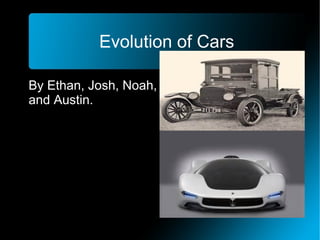
- 1. Evolution of Cars By Ethan, Josh, Noah, and Austin.
- 2. Nicholas Joseph Cugnot ● Built first self propeled car ● It went up to 2 miles per hour ● First one crashed into a brick wall ● First ran in 1769 ● Made in France
- 3. Karl Benz ● He invented his first car in 1888 ● He designed it in 1885 ● Benz invented the first motorbike ● His wife test drove his first model ● Invented the first gas powered car ● Invented in Germany
- 4. Henry Ford ● Improved the assembly line for the automobile ● Made cheap automobiles ● Made Ford Motor Company in dearborn michigan in June, 16, 1903 ● Created the Model T
- 5. Car Additions ● 1914 car bodies are made out of steel ● 1920's Radios are installed into cars ● 1939 Air condition is added ● 1940 Jeeps are designed for military purposes only ● 1950's Cruise control developed ● 1970's air bags become standard
- 6. Gasoline cars ● Most cars are now gasoline powered ● In 2010 gas powered cars went to 1 billion from 500 million originaly set in 1983 ● Gas engines started being used in 1980 in America ● Gas powered engine made by Karl Benz
- 7. Electric Cars ● Gas prces have gone up, so a lot of people have switched to electric cars. ● They cut down on pollution ● 133,000 electric cars have been manufactered since 2008. ● $2.4 billion has been given from the government to support next generation cars.
- 8. In the future... ● All cars are electric ● 50 miles per gallon ● Car never break down ● Cars don't make as much noise ● Self driving and self-parking cars