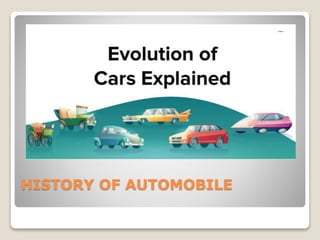
The development of the automobile began in the late 17th century. Steam power was an early attempt at portable power but internal combustion engines eventually proved more practical. The first internal combustion engine automobile was built in 1885 by Karl Benz. Henry Ford's assembly line techniques helped the Model T become the first affordable automobile for mass consumption in the early 20th century. Modern features like power steering, air conditioning, and electronics have since been incorporated to enhance comfort, safety and navigation.
In the late 1800s, German inventors Karl Benz and Gottlieb Daimler independently developed early automobile prototypes powered by internal combustion engines. In 1888, Bertha Benz, wife of Karl Benz, took the first road trip in their motorwagen from Mannheim to Pforzheim in Germany to promote her husband's invention. By the early 1900s, automobiles had become commercially viable, mass-produced products that began transforming transportation, infrastructure, and culture around the world. Major developments in the following decades included the rise of the American auto industry, the expansion of highways and suburbs, increasing popularity of customization, and growing environmental and safety concerns associated with automobile use.
This is the history of one of man's greatest inventions.... The Car! This slideshow discusses the major accomplishments in chronological order since the very beginning of the automobile.
A car (or automobile) is a wheeled motor vehicle used for transportation. Most definitions of cars say that they run primarily on roads, seat one to eight people, have four tires, and mainly transport people rather than goods.
The history of automobile where they startRydenBueno
The development of the automobile began in the late 17th century with early steam-powered vehicles and the first steam-powered car built in 1769. In the early 19th century, inventors created some of the first internal combustion engines and electric motors to power cars. The first modern, practical automobile for everyday use appeared in 1886 when Carl Benz developed a gasoline-powered car and began mass production. In the late 19th and early 20th centuries, many inventors and companies, including Oldsmobile and Ford, further advanced automotive technology and pioneered assembly line production, making cars more widely available and affordable to the public.
From Europe to the US Japan and onto China: The evolution of the automobile i...Murray Hunter
This document provides a historical overview of the evolution of the automobile from its origins in Europe in the late 18th century to its development in the US and Japan and more recently in China. It discusses early steam-powered vehicles and developments that led to gasoline-powered internal combustion engines. Pioneers like Daimler, Benz, and Ford are credited with important innovations that advanced automotive technology and popularity. The document also outlines the parallel development of key components like rubber tires by Thomson, Dunlop, and Michelin. It concludes by noting the recent rise of Chinese automakers like BYD, Lifan, and Geely as the fourth generation of modern automobile manufacturers.
This document provides a timeline of key developments in self-propelled vehicles from 1335 to 1886. Some of the earliest developments include a windmill-driven war wagon designed by Guido da Vigevano in 1335 and a clockwork-driven tricycle designed by Leonardo Da Vinci in 1478. Other important milestones mentioned include Nicholas Cugnot's steam-powered vehicle in 1769, widely considered the first automobile; Richard Trevithick's steam locomotive demonstration in 1801; and Karl Benz's gasoline-powered automobile, the Benz Patent-Motorwagen, in 1886, regarded as the first practical automobile. The timeline shows the progression from early human-powered vehicles to early steam-powered
Automobile Industry - history, evolution & growthRohith Sainoji
The document provides an overview of the history and development of automobiles. It discusses key events and innovations such as Cugnot building the first steam-powered vehicle in 1769, Benz receiving a patent for the first gasoline-powered automobile in 1886, and Ford revolutionizing production with assembly line techniques beginning in 1914. The document also covers the growth of the global automobile industry in the 20th century and its current challenges around sustainability and external competition from public transportation.
The car has evolved significantly from early steam-powered vehicles to modern cars with internal combustion engines. Some key developments include Nicolas Cugnot creating the first steam-powered road vehicle in 1769, Richard Trevithick improving steam engine designs and putting them on wheels in 1801, and Gottlieb Daimler and Karl Benz creating the first successful gasoline-powered vehicles in the 1880s. By the early 1900s, Ford was mass producing affordable cars and technologies like electric starters and brakes were being developed. More recent innovations include hybrid engines, advanced safety features, and controls on emissions.
The industrialization period between 1850-1914 saw the introduction of many technologies that enabled mass production and new industries. This included improvements in steel production and a large increase in the number of companies. Major inventions like the car and light bulb emerged during this time, transforming society. The first modern car capable of 10 mph was created by Karl Benz in 1886.
Possibly the first powered vehicle was a steam-powered toy built in 1672 for the Chinese Emperor by Flemish Priest Ferdinand Verbiest. It wasn’t until the late 18th century that steam-powered vehicles were able to carry people, and later attempts were made to develop this, with brakes, transmissions, and improved steering introduced.
THE GREAT INVENTIONS OF LAND AND PIPELINE TRANSPORT IN HISTORY AND ITS FUTURE...Fernando Alcoforado
This article aims to present the great inventions that contributed to the development of land and pipeline transport throughout history, as well as to show their probable future evolution. The means of land transport operate in the transport of people and cargo within cities and in the exchange between cities, states and surrounding countries, contributing to the economic and social development of a country or a region [3, 4. 5 and 6]. Land transport means are classified as rail, which use trains, electric trams and inclined planes, road transport, which use buses, cars, trucks, bicycles and motorcycles, subways that use the subway, as well as other means of transport such as urban elevators and cable cars. Pipeline or tubular means of transport are those made by means of tubes (gas pipelines, oil pipelines, alcohol pipelines, ore pipelines) to transport gases and fluids. This article presents in detail how the invention of the railway, the subway, the electric tram, the motor vehicle (internal combustion car, electric car and autonomous vehicle), the truck, the bicycle, the motorcycle, the elevator and ducts. In addition, it presents in detail what the land transport of the future will look like in urban centers, on railway lines and on highways
1) The document discusses the history of cars from early steam-powered vehicles in the 1700s to the development of gasoline-powered combustion engines and mass production in the late 1800s and early 1900s.
2) It notes key events like Karl Benz inventing the first gasoline-powered car in 1886 and Henry Ford developing the Model T for mass production.
3) The final section covers advantages and disadvantages of car usage, noting they provide convenience and speed but require money, cause pollution, and can lead to accidents.
1. A wheel is a circular component that rotates on an axle and is one of the main components of the wheel and axle simple machine.
2. Wheels allow for heavy objects to be moved easily and support loads to facilitate movement and transportation.
3. Beyond transportation, wheels are used for other purposes like ship wheels, steering wheels, and flywheels.
1) The document provides a history of the development of gas turbine engines from early concepts like Hero of Alexandria's aeolipile in the 1st century to modern trends.
2) Key developments included Frank Whittle's patent for a gas turbine engine in 1930 and the first flight of a jet-powered aircraft by Germany in 1939.
3) Modern gas turbine engines are classified based on their compressor type and power usage, including turbojet, turbofan, turboprop, and turboshaft engines used in aviation and other industries.
The document summarizes the history of automobiles from their origins in the late 18th century to modern developments. It notes that Karl Benz is considered one of the founders of Mercedes-Benz and built the first automobile powered by an internal combustion engine in 1885. It then outlines key developments over the 20th century like the introduction of synchronized transmissions, braking systems, and new materials. The document concludes that computers now control many vehicle systems and autonomous vehicles may be the future of transportation.
The automobile revolution began in the late 18th century with early experiments by inventors like Trevithick and Cugnot. Major advances occurred during the Industrial Revolutions of the late 1700s and early 1800s with the development of steam power, as well as the second Industrial Revolution from 1870-1880 with the rise of oil and electricity. These technological changes enabled mass production of affordable automobiles in the late 1800s and early 1900s, driving major social and economic changes as automobiles became widely adopted.
Nicolas-Joseph Cugnot built the first self-propelled mechanical vehicle in 1769. Rudolf Diesel developed the compression ignition engine in the late 19th century. The first practical petrol engine was built by Nikolaus Otto in 1876. Karl Benz received a patent for the first practical motorcar, powered by a petrol engine, in 1886. In the early 20th century, hybrid vehicles began to emerge, combining petrol engines with electric motors. Automotive technology has since focused on improving comfort, safety, and value for humans.
The document summarizes the history and development of automobiles from the 15th century to present day. It describes how the first self-propelled vehicles were invented in the 15th century in China and then developed in Europe in the 18th century. Nicolas Joseph Cugnot is credited with building the first true automobile in 1769. Steam power was used initially but was replaced by gasoline engines in the late 19th century. Henry Ford's Model T in 1908 made cars more affordable and accessible to the masses. Technology continued advancing throughout the 20th century with smaller engines but more horsepower and new safety features that are now standard in modern cars.
The electric vehicle was popular in the early 1900s, outselling gasoline cars between 1899-1900. However, they then declined as better roads connected cities requiring longer ranges, gasoline became cheaper, and Henry Ford's mass production made gasoline cars more affordable. Interest renewed in the 1960s/70s due to concerns over emissions and oil dependence. Companies like Battronic and Elcar produced electric trucks and passenger vehicles during this time, though electric cars then again faded from the market.
International Journal of Microwave Engineering (JMICRO)jmicro
International Journal of Microwave Engineering (JMICRO) is a peer-reviewed, open access journal which invites high quality manuscripts that focuses on Engineering and theory associated with microwave /millimeter-wave technology, guided wave structures, electromagnetic theory and implementation. Authors are invited to submit original research works that stimulate the development of latest technology in industry and academia. Good quality review papers and short communications are also acceptable.
Design of Automatic Car Washing System and Construct Prototype.pdfrahulchaure14
Design of Automatic Car Washing System and Construct Prototype
all information on this project design calculation, arduino program, proto model 3d model
Volvo EC180C L Hydraulic Tank Repair Manual
Service Repair Manual Cover:
General
Safety
1 Standard Parts, Service
2 Engine with Mounting and Equipment
3 Elec. System, Warning System, Information System, Instruments
4 Power Transmission
5 Frame and Crawler Unit
6 Machinery House, Cab, Exterior Trim Parts Anywhere
7 Hydraulic System, Digging, Handling, Grading Equipment
Power Metering Market Global Trends and Forecast Analysis (2023-2032)PriyanshiSingh187645
The Power Metering Market is projected to grow from USD 21,125 million in 2024 to USD 32,322.05 million by 2032, reflecting a robust compound annual growth rate (CAGR) of 5.46%.
Volvo L70F Wheel Loader Engine Service ManualExcavator
Volvo L70F Wheel Loader Engine Service Manual
l70 volvo specs, Service manual has easy-to-read text sections with top quality diagrams and instructions.
Covers:
Safety
General
Standard Parts, Service
Engine with Mounting and Equipment
Elec. System, Warning System, Information System, Instruments
Power Transmission
Brake
Steering
Frame and Wheel
Machinery House, Cab, Exterior Trim Parts Anywhere
Hydraulic System, Digging, Handling, Grading Equipment, Misc Equipment
Hydraulic and Electrical Schematics
2. You must have heard the word Automobile.
Meaning of an automobile can, be auto
car, motor car or car. It is a wheeled motor
vehicle used for transporting goods or
passengers, which also carries its own engine
or motor. The word automobile comes from
the Ancient Greek word (autos, "self") and the
Latin mobilis ("movable"); therefore
automobile means a vehicle that moves itself
3. Development of the automobile started in 1672 with the invention
of the first steam-powered vehicle, which led to the creation of
the first steam-powered automobile capable of human
transportation, built by Nicolas-Joseph Cugnot in 1769.Inventors
began to branch out at the start of the 19th century, creating
the de Rivas engine, one of the first internal combustion
engines, and an early electric motor. Samuel Brown later tested
the first industrially applied internal combustion engine in 1826.
The Ford Model and Volkswagen Beetle are among the most
mass-produced car models in history.Development was
hindered in the mid-19th century by a backlash against large
vehicles, yet progress continued on some internal combustion
engines. The engine evolved as engineers created two-
and four-cycle combustion engines and began
using gasoline as fuel. Production vehicles began appearing in
1887, when Carl Benz developed a gasoline-powered
automobile and made several identical copies.Recent
automobile production is marked by the Ford Model T, created
4. NOW WE WILL UNDERSTAND IN
DETAILS
Stages of developments in
AUTOMOBILE fuel sources
Steam Engine
Electric engine
Internal Combustion Engine
5. POWER SOURCE
The early history of the automobile was
concentrated on the search for a reliable portable
power unit to propel the vehicle.
STEAM POWERED VEHICLE
Ferdinand Verbiest, a member of a Jesuit mission
in China, built a steam-powered vehicle around
1672 as a toy for the Kangxi Emperor. It was small-
scale and could not carry a driver but it was, quite
possibly, the first working steam-powered vehicle
('auto-mobile').
6. Steam-powered self-propelled vehicles large enough to
transport people and cargo were first devised in the late 18th
century. Nicolas-Joseph Cugnot demonstrated his fardier à
vapeur ("steam dray"), an experimental steam-driven artillery
tractor, in 1770 and 1771. The center of innovation shifted to
Great Britain. By 1784, William Murdoch had built a working
model of a steam carriage in Redruth and in 1801 Richard
Trevithick was running a full-sized vehicle on the roads
in Camborne.
17th and 18th centuries
7. 19th century
During the 19th century, attempts were made to
introduce practical steam-powered vehicles.
Innovations such as hand brakes,
multispeed transmissions and better steering
developed. Some commercially successful vehicles
provided mass transit until a backlash against these
large vehicles resulted in the passage of legislation
such as the UK Locomotive Act (1865), which
required many self-propelled vehicles on public roads
to be preceded by a man on foot waving a red flag and
blowing a horn. This effectively halted road auto
development in the UK
8. In 1816, a professor at Prague Polytechnic, Josef Bozek, built an oil-fired
steam car.Walter Hancock, builder and operator of London steam
busses, in 1838 built a two-seated car phaetonOne of the first "real"
automobiles was produced in 1873 by Frenchman Amédée Bollée in Le
Mans, who built self-propelled steam road vehicles to transport groups
of passengers.The first automobile suitable for use on existing wagon
roads in the US was a steam-powered vehicle invented in 1871 by Dr. J.W.
Carhart, a minister of the Methodist Episcopal Church, in Racine,
Wisconsin. It induced the state of Wisconsin in 1875 to offer
a US$10,000 (equivalent to $246,758 in 2021) award to the first to
produce a practical substitute for the use of horses and other animals.
They stipulated that the vehicle would have to maintain an average
speed of more than 8 km/h (5 mph) over a 320 km (200 mi) course. The
offer led to the first city to city automobile race in the US, starting on 16
July 1878 in Green Bay,. While seven vehicles were registered, only two
started to compete: the entries from Green Bay and Oshkosh. The
vehicle from Green Bay was faster but broke down before completing the
race. The Oshkosh finished the 323 km (201 mi) course in 33 hours and
27 minutes and posted an average speed of 9.7 km/h (6 mph). In 1879,
the legislature awarded half the prize
9. 20th century
Steam-powered road vehicles, both cars and wagons, reached
the peak of their development in the early 1930s with fast-
steaming lightweight boilers and efficient engine designs.
Internal combustion engines also developed greatly
during World War I, becoming simpler to operate and more
reliable. The development of the high-speed diesel engine
from 1930 began to replace them for wagons.No significant
developments in the production of steam cars took place
after Doble in 1931.
10. Electric automobiles
Electric cars enjoyed popularity between the late
19th century and early 20th century, when
electricity was among the preferred methods for
automobile propulsion, providing a level of
comfort and ease of operation that could not be
achieved by the gasoline cars of the time.
Advances in internal combustion technology,
especially the electric starter, soon rendered this
advantage moot; the greater range of gasoline
cars, quicker refueling times, and growing
petroleum infrastructure, along with the mass
production of gasoline vehicles by companies
such as the Ford Motor Company, which reduced
prices of gasoline cars to less than half that of
equivalent electric cars, led to a decline in the use
of electric propulsion, effectively removing it from
important markets such as the US by the 1930s
11. Internal combustion engines
Gas mixtures
The lack of suitable fuels, particularly
liquids, hampered early attempts at
making and using internal combustion
engines therefore some of the earliest
engines used gas mixtures. Several early
experimenters used gases. In 1806, the
Swiss engineer François Isaac de
Rivaz built an engine powered by internal
combustion of
a hydrogen and oxygen mixture.
12. GASOLINE
Nicolaus Otto and Eugen Langen had built a
working engine in 1867. About 1870,
in Vienna, Austria (then the Austro-
Hungarian Empire), inventor Siegfried
Marcus put a liquid-fueled internal
combustion engine on a simple handcart
which made him the first man to propel a
vehicle by means of gasoline. Today, this is
known as "the first Marcus car" but would be
better described as a cart. In 1883, Marcus
secured a German patent for a low-
voltage ignition systemSeveral inventors
developed their own version of practical
automobiles with petrol/gasoline-powered
internal combustion engines in the last two
13. Karl Friedrich Benz, was a German engine designer
and automotive engineer. His Benz Patent
Motorcar from 1885 is considered the first
practical automobile and first car put into series
production.He received a patent for the motorcar in
1886.The world's first ever long distance automobile
trip was undertaken by Bertha Benz using a Model 3.
On the morning of 5 August 1888 Bertha –
supposedly without the knowledge of her husband –
took the vehicle on a 104 km trip from Mannheim
to Pforzheim to visit her mother, In addition she
repaired various technical and mechanical problems.
One of these included the invention of brake lining;
after some longer downhill slopes she ordered a
shoemaker to nail leather onto the brake blocks.
Bertha finally arrived at nightfall, announcing the
achievement to Karl by telegram. It had been her
intention to demonstrate the feasibility of using the
14. POWER STEARING
The first power-steering system fitted to a production
car debuted in the 1951 Chrysler Imperial, and the
competition quickly followed suit. Not only did
power steering do the obvious—allow the driver to
steer a heavy vehicle with much less effort and
greater comfort—but it also allowed engineers to
improve steering response, which is how quickly the
car changes direction when the driver turns the
wheel. A car without power steering is a significantly
rare thing, but there is one out there: the Alfa Romeo
4C
15. Headlights are an essential part of today's vehicles -
most of us couldn't imagine driving around without
them. But, when was the headlight invented. The
first headlights were invented in the 1880s, around
the time the automobile was invented. However,
headlights were far from standard in these early
vehicles. Without the power of electricity, it was
nearly impossible to build a headlight that worked.
The very first headlights were acetylene lamps.
These contained a small flame, which could
withstand some wind and rain. Electric headlights
were first developed in 1898,In 1900s that electric
headlights became more mainstream.Cadillac created
cars with the first modern electric system, including
electric headlights. In 1913
16. The first prototype was attributed by Karl Benz. Wilhelm
Maybach designed the first honeycomb radiator for the
Mercedes 35hp which was the very first successful
vehicle with a cooling system.In 1941, 300 Cadilacs were
manufactured with an air conditioning system.Chrysler
also produces some of the cars that year with air-
conditioning system.In 1948 the Automotive Refrigerated
Air Conditioning(ARA) Company was first to offer
aftermarket automotive air-conditioning systems.By the
mid-1950s there were more than fifteen companies
offering air-conditioning system in kit form. The 1940
Packard was the first car to offer factory-installed air-
conditioning. By 1969, more than half of all new cars sold
were equipped with A/C
18. In 1924, Kelly's Motors in NSW, Australia, installed its
first car radio. In 1930, the American Galvin
Manufacturing Corporation marketed a Motorola
branded radio receiver for $130. It was expensive: the
contemporary Ford Model A cost $540. It was first
developed by the U.S. Department of Defense
in 1973 for use by the United States military, though
an early satellite-based system called TRANSIT had
been in use as early as 19601981: Honda's Electro
Gyrocator was the first commercially available car
navigation system. It used inertial navigation
systems, which tracked the distance traveled, the
start point, and direction headed. It was also the first
with a map display. 1981: Navigation computer on
the Toyota Celica (NAVICOM).
19. Name:- Alok kumar Vaidya
Class:-9 F
Roll no:-07